
Kickboxing or BJJ: Which First
Compare | Side by Side
Kickboxing or BJJ: Which Should You Start First
Start with the one you're most likely to keep showing up for. Kickboxing teaches you to punch, kick and defend yourself on your feet, and Brazilian Jiu Jitsu teaches you to control someone and get out from under them on the ground. Both are good first steps, and a lot of people who stick with one end up adding the other later.
How to pick
- 01
Pick the one you're excited about
Ask yourself which class you'd still go to after a long day at work. If pad work and kicking a bag sound fun, start with kickboxing. If working out a puzzle on the mat sounds fun, start with jiu jitsu. Wanting to be there is what keeps you coming back once the first few weeks wear off.
- 02
Think about the contact
The two feel very different. Kickboxing is mostly done at arm's and leg's length: you hit pads, the bag and a partner's mitts, and sparring is optional. Jiu jitsu is close contact from the first class, chest to chest with a partner, but nobody is punching you. Striking is harder on shins, hands and wrists, and grappling on necks, knees and fingers, which is why you tap early and train with control in both. If you have an old injury or a health condition, check with your doctor and tell the coach. Some people are more comfortable with one than the other, and that's a fair way to choose.
- 03
Think about what you want out of it
If you mostly want a hard workout, both will do it, and a round on the pads or a round on the mat will both leave you breathing hard. If you want to learn to fight on your feet, start with kickboxing. If you want to know how a smaller person can control a bigger one, start with jiu jitsu. If you want MMA (mixed martial arts) someday, you'll want both, and either one is a fine place to start.
- 04
Know how the first month feels
Most classes start with a warm up, then the coach shows a move and you drill it with a partner. Striking usually feels like progress sooner, because a jab and a cross start to look decent within a few classes. Jiu jitsu has a steeper start, since moving on the ground is new even for good athletes, and feeling lost for the first few weeks is normal. Neither is a reason to skip one. It just helps to know what's coming so you don't quit early.
- 05
Try it, then stick with it
Use your free pass on the one you're leaning toward, and tell the coach it's your first class and that you're curious about the other one too. That way you get paired with a patient partner. How the room feels and how the coach explains things will tell you more than reading about it, so give it a real month before you decide anything.
What each one gives you
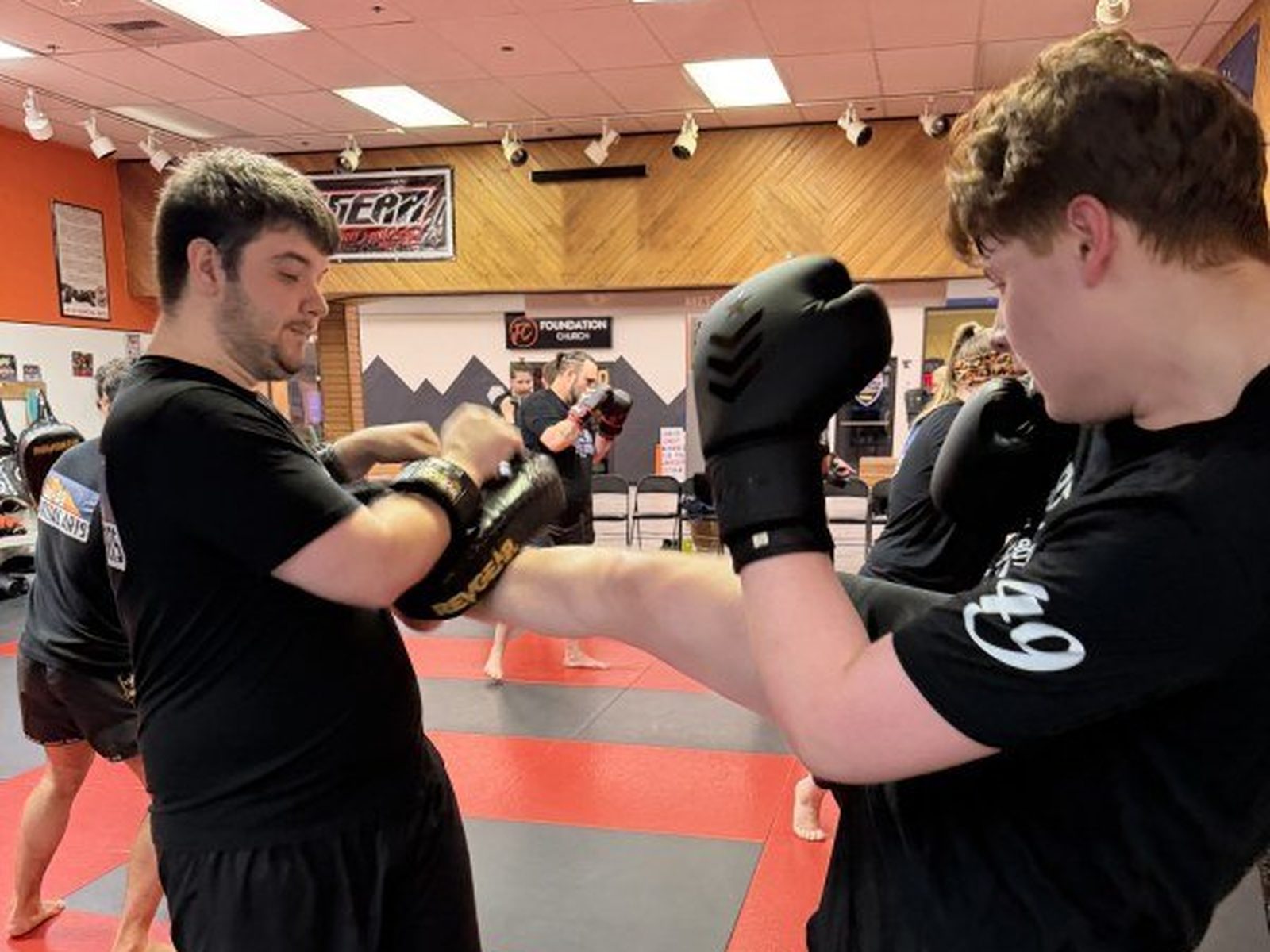
Kickboxing. You learn to punch and kick, and to keep your hands up to protect your head. You also learn distance: how far a punch or a kick reaches, and how to step out before one lands. Class moves fast between pads, the bag and drills, so your conditioning picks up quickly. Sparring is optional, and once you spar you wear a mouthguard, and men wear a cup. The balance and footwork carry into everything else you learn later.
Brazilian Jiu Jitsu. You learn to stay calm with someone on top of you, get out from the bottom and hold someone down without needing to be bigger. You learn to tap when you're caught, and your partner lets go right away. The pace is slower at first, and you can train hard without taking punches. The ground is where new people tend to feel the most lost, so learning it early pays off if you add striking later. Shower after training, keep your nails short, and get any rash or skin spot checked and cleared before you roll again.
Things to look out for
Waiting to get in shape first
You put off your first class for weeks or months so you can get fit first. The weeks go by, you never start, and the shape you were waiting for is the shape the classes would have given you.
The fix: Come as you are and take a break when you need one. A few weeks of training is what gets you in better shape. Grab some water, catch your breath and jump back in.
Doing both full speed in week one
You try to make every kickboxing and every jiu jitsu class in your first week. You end up sore, short on sleep and mixed up, because two new arts at once means twice the new words and twice the new movements.
The fix: Pick one as your base and train it two or three times a week for the first couple of months. Once the basics stop feeling brand new, add one class a week of the other. Keep an easier day after a hard one so your body can catch up.
Quitting the first time you feel lost
Your feet get crossed up in kickboxing, or you can't figure out where your arms go on the mat, and you decide it isn't for you. Everybody feels that early on. The people who leave at that point never get to the part where it clicks.
The fix: Give it a full month before you judge it. Take one thing home from each class and write it down after, with the one detail that made it work. By week four a lot more of it makes sense.
Picking by what the internet says is best
You read arguments online about which art wins on the street and pick the winner, even though you don't enjoy it. If you dread a class you'll skip it, and you don't learn anything from a class you skipped.
The fix: Pick by what you want and what you'll keep doing. Every art has things it covers and things it doesn't. Real self defense starts with awareness, and the physical side comes from training regularly over time in whichever one you choose.
Buying gear before your first class
You buy gloves, shin guards or a gi before you've tried the class. Sometimes it's the wrong gear for how that class trains, and sometimes you end up liking the other art and it sits in the closet.
The fix: Come in a shirt and shorts, whatever is comfortable. Any equipment you need for class is provided and gi classes have loaner gis, so you can sort out your own gear once you know what you like.
Frequently Asked Questions
Which is better for self defense, kickboxing or jiu jitsu?+
Both help, in different ways. Striking teaches you to keep your distance, protect your head and make enough space to get away. Jiu jitsu teaches you to stay calm when someone grabs you or pulls you down, and how to get back up. On the street, staying on the ground is risky if anyone else is around, so the goal there is to get up and away. Real self defense starts with awareness, and the physical side comes from training regularly over time, so pick the one you'll keep doing.
Which is easier for a beginner?+
Most people feel progress sooner in kickboxing, because the punches and kicks start to look decent within a few classes. Jiu jitsu has a steeper start, since moving on the ground is new even for people who played other sports. Both get easier the more you show up. Neither one is too hard to begin.
Will I get hit in my first class?+
Not on purpose. In your first kickboxing class you hit pads and the bag with a partner, then switch and hold for them, and sparring is optional. In your first jiu jitsu class you drill moves with a partner, and live rounds are optional too. A bump can happen in partner drills, but new students get paired with patient partners, and nobody asks you to do more than you're ready for.
Can I train both at the same time?+
Yes, you can train one side or both. Most beginners do best picking one as their base for the first couple of months, then adding a class a week of the other once the basics feel steady. Try not to stack two hard sessions on back to back days while you're new. Both arts teach things the other doesn't, so adding the second one later fills in the gaps.
Which should my kid start with?+
Start with the one your child is most curious about. Kids BJJ is for ages 6 and up and Kids Kickboxing is for 7 and up, so a 6 year old can start with jiu jitsu now. Both teach coordination, listening and respect, and kids can add the other class later.
Are You Ready?