
How to Kick Harder
Kickboxing | Kicks
How to Kick Harder in Kickboxing
Kicking harder comes from your feet and hips more than from swinging the leg harder. For your back leg round kick, step out to lengthen your stance, get up on the ball of your front foot, pivot, and let your hip, shoulder and head turn through the kick, all from a good athletic base with your hands up. Timing and where the kick lands matter as much as how hard it hits. This page covers the back leg round kick, where most of your power lives. The same ideas of a step, a pivot and the hip carry over to lead leg kicks later.
- 01
Good athletic base
Start in your stance: feet about shoulder width apart, front toes pointing forward, knees a little bent and your weight in the middle. This shorter stance is the one you defend from. You lengthen it only when it's time to kick.
- 02
Hands up, elbows in
Both fists sit at your cheeks with your elbows in close to your ribs. The hand on the side you're not kicking with stays on your face from the first step until your foot is back down. Flinging your arms out adds nothing to the kick and leaves your head open.
- 03
Step out and lengthen
For a back leg kick, step your front foot forward and a little outside the center line, pushing off your back foot. Step only as far as keeps your front knee over your front foot, so you don't crowd the target. The step moves your weight into the kick, and the longer stance gives the hip room to swing through. Think of a baseball swing: you don't hit a home run from a bunt stance.
- 04
Get on your calf
Land that step on the ball of your front foot with the heel off the floor, so you're driving up through your calf. Staying on the ball of the foot is what lets you pivot. A flat front foot glues your hip in place.
- 05
Pivot so the hip turns over
Turn your front foot as the kick goes, often around 90 degrees on a full power kick, until your heel points toward the target. What you're after is the hip turning over, and the foot turns as far as the hip needs. Too little and your hips never turn over. Spin far past that and it's hard to get back to your stance.
- 06
Shoulder back, head up
Pull the shoulder on your kicking side back to open the hip, and keep your head up over your hips with your chin tucked instead of leaning away from the kick. The weight of your head going into the kick makes it heavier. Leaning back takes that weight out and usually means you stepped too close or too far.
- 07
Stay loose until it lands
Keep the leg relaxed as it swings and keep a slight bend in the knee, then tighten up as the shin lands. A stiff leg is a slow leg, and a leg stretched out straight only has the power of the lower leg. Land with the lower half of your shin, not your foot or your knee, and aim to kick through the target, as if it were a few inches deeper than it is. Keep breathing steady, and let a breath out as it lands.
- 08
Back to your stance
Bring the leg straight back down and land in your stance with your hands on your face. A hard kick you can't recover from leaves you open. You should be ready to throw again the moment your foot touches down.
When to use it
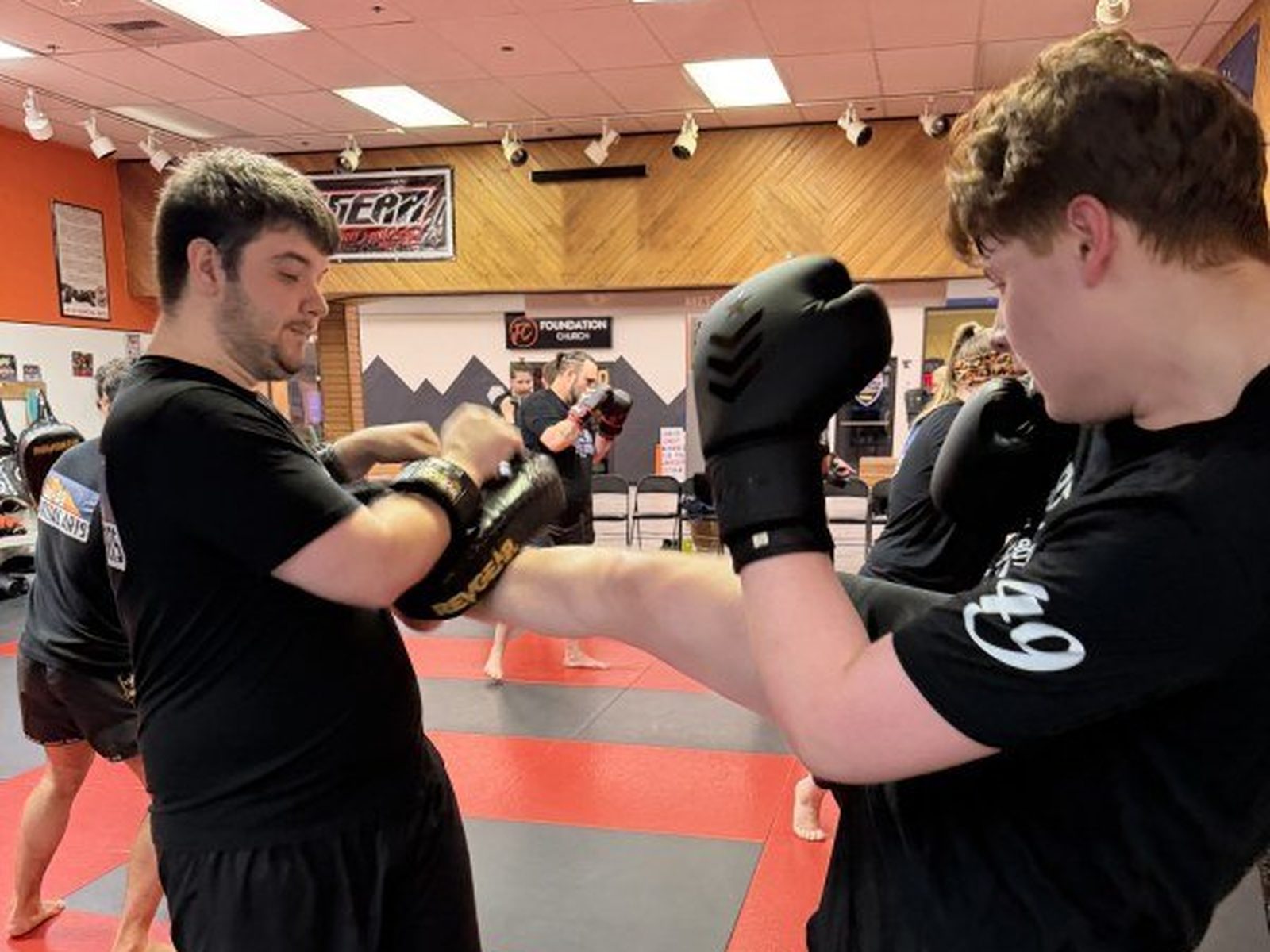
On the bag and the pads. Bag rounds and pad rounds are where you practice full power, because the target doesn't move and you can feel every kick land. Set your feet, step, pivot and turn the hip through on each one. Check how the kick felt, reset to your stance, and throw the next one. Build power over weeks, starting around half power while your shins get used to the bag. Sore shins are normal early, and sharp pain or a lump that won't fade means rest and get it checked. On pads, the holder stands where your kick lands with the shin at the end of your step, not where you'd have to reach.
At the end of a combination. Not every kick needs full power. A kick that sets up punches uses a smaller pivot, about 45 degrees or less, so you can punch right after it. A kick at the end of a combination, like jab, cross, kick, is where you put everything into it. Learn both, and use the full power kick when nothing else needs to come after it.
Things to look out for
Kicking from a standstill
You throw the kick straight from your stance with no step. There's no weight moving into it, so the kick is all leg and lands light.
The fix: Step out and push off your back foot every time you want power. Step, then kick, until it feels like one move.
Short stance
Your feet stay close together as you kick. The hip has no room to swing, so it feels like a bunt instead of a full swing.
The fix: Let the step lengthen your stance before the kick goes. You should feel loaded, like you're winding up to swing a bat.
Flat front foot, no pivot
Your front foot stays flat and pointing forward. Your hip can't turn over, so you lose most of your power.
The fix: Get up on the ball of the foot and let it turn as you kick. Feel the foot turn under you as the hip comes through.
Over pivoting
You spin the front foot all the way around until your back is nearly facing the target. You can't get back to your stance, and you're off balance after every kick.
The fix: Turn the front foot only as far as your hip needs to turn over, which for most people is around 90 degrees. Kick, then come back to the stance you started in.
Leaning back
Your head goes back as your leg goes forward. The weight of your upper body goes away from the kick, and your chin sticks out.
The fix: Keep your head up over your hips, chin tucked, and your hands on your face. If you keep leaning back, check your step: you're probably too close or too far.
Muscling it
You tense your whole body and swing as hard as you can. The kick gets slower, you lose your balance, and you're tired after a few kicks.
The fix: Stay loose and let the step, pivot and hip do the work. Speed and a clean turn hit harder than force.
Swinging your arms for power
Both hands fly out to help the kick. It doesn't add power, and your head is open the whole time.
The fix: Keep the hand on the other side on your face every kick. Watch it in a mirror while you shadow box.
What to Practice at Home
Drill 01
Film your kicks
Warm up first with a few minutes of easy movement, leg swings and light kicks. Then prop your phone on the floor and film 2 sets of 10 kicks on each leg, once from the side and once from the front. Rest 1 minute between sets. Watch the clip for your step angle, whether your heel stays up, and how far your front foot turns. You'll see things you can't feel.
Drill 02
Freeze at the end
3 sets of 8 slow kicks per leg with 1 minute rest. Kick in slow motion and hold the finish for 2 seconds: on the ball of the foot, front foot turned, head up over your hips, other hand on your face. Then bring the leg back to your stance. If you can't hold the finish, something in the step or pivot is off.
Drill 03
Power rounds
3 rounds of 2 minutes with 1 minute rest on a heavy bag. With no bag, shadow box it at half speed and never snap the knee out straight into the air. Round one, quick setup kicks with a small pivot and a punch right after. Round two, single power kicks with a full step and pivot, resetting your stance between each one. Round three, alternate the two. Start light and add power as the form holds up.
Frequently Asked Questions
How can I kick harder?+
Step out to lengthen your stance, get on the ball of your front foot, pivot, and turn the hip and shoulder through. Keep your head up over your hips and stay loose until it lands. Most of the power comes from the feet and hips.
Should my leg be straight when I kick?+
Not fully straight. Keep a slight bend in the knee. A leg stretched out straight only has the power of the lower leg. The bend lets your whole body go into the kick.
How far should I pivot when I kick?+
For a full power kick, far enough that your hip turns over, which is often around 90 degrees with your heel pointing at the target. For a quick setup kick, pivot less so you can punch right after. Turning much past that makes it hard to get back to your stance.
Do I need to get stronger to kick harder?+
Technique comes first, and most beginners gain a lot of power just by fixing the step and pivot. Stronger, looser hips help over time. Regular kicking on the bag builds a lot of that on its own.
Is kicking hard the most important thing?+
Not on its own. When you kick and where the kick lands matter as much as how hard it is. A well timed kick at the right angle beats a hard one they saw coming.
Are You Ready?