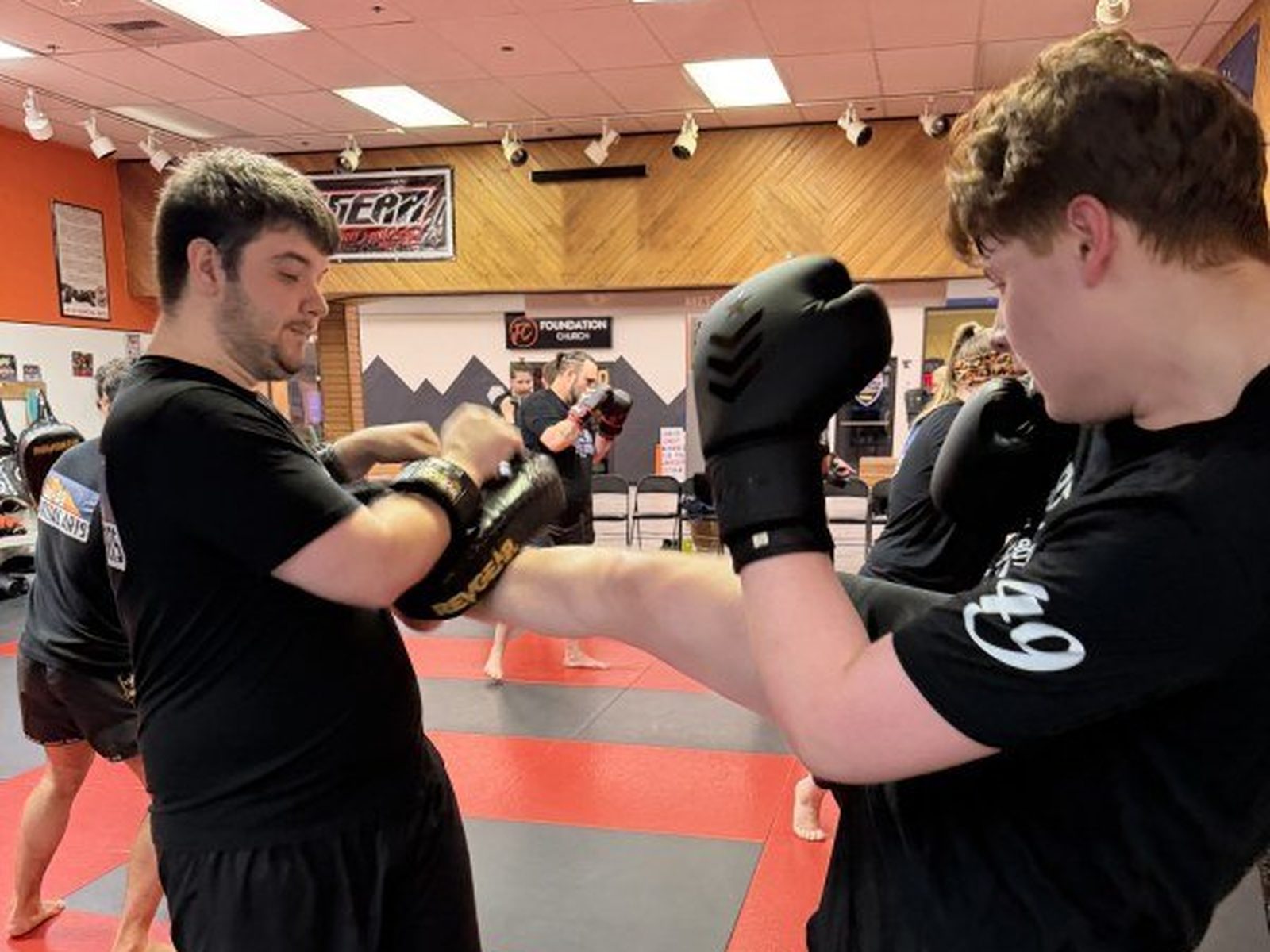
Diagonal Knee
Muay Thai | Knees
How to Throw a Diagonal Knee in Muay Thai
The diagonal knee drives up and in at an angle, around the other person's guard and into the ribs. You throw it from close range, up on the ball of your standing foot with your heel tucked to your butt and your hands still at your face. It works best once you have a good straight knee, and it's the one to reach for when their arms are covering the middle.
- 01
Good athletic base
Start in your stance with your feet about shoulder width apart, knees a little bent and your weight in the middle. You're about to stand on one leg, so the balance has to be there before the knee goes. If you're wobbly in your stance, you'll be wobbly on the knee too.
- 02
Hands up, elbows in
Both fists stay up at your cheeks with your elbows in close to your ribs. Knees happen at close range, where punches land easily, so your hands stay up from the first step until your foot is back down. Either keep them at your face or reach them out over the other person's hands to cover their punches as you come in. Don't let them drop to your hips.
- 03
Get close first
A knee is shorter than a kick, so you have to be close for it to land. Punches, a faked kick or a clinch are what get you there. If you throw the knee from kicking range, it hits air and leaves you standing on one leg in front of them.
- 04
Up on the ball of your foot
As the knee comes up, rise onto the ball of your standing foot and let that foot turn out, roughly 45 degrees, as your hip turns over toward the target. If you have a hold on their neck or arm, pull them a little across toward the knee at the same time. Being on the ball of the foot lets you throw the knee and bring it back under control. Flat on your foot, you tend to fall forward after the knee.
- 05
Heel to your butt
Fold the leg so your heel tucks up toward your butt. That makes the knee a sharp point, like the tip of a knife. If the foot hangs out in front, the knee lands soft and tends to drift low.
- 06
Up and in at an angle
Drive the knee, usually your back knee since it has more room to build speed, up and in on a diagonal, around their elbow and into the ribs or the side of the body. The power comes from pushing your hips through, the same as the straight knee, only on an angle. Keep your chest up and your upper body leaning back just a touch, so your head stays out of their reach. Keep breathing steady, let a breath out as it lands, and keep your eyes on their chest.
- 07
Back to your stance
Land the foot under control, set slightly forward, and get straight back into your stance with your hands on your face. Don't fall into them or spin past them. From your stance, follow with your hands or reset.

When to use it
When their arms cover the middle. When someone tucks their elbows in tight to protect their stomach, a straight knee runs into their arms. The diagonal knee comes in on an angle and goes around the elbow to the ribs. That's why the two knees work as a pair. Throw the straight knee up the middle, and when they close it off, go around the side.
When they lift a leg to check. Throw a couple of light leg kicks so they start lifting a leg to check them. Next time, take the same step like the kick is coming, and when the leg comes up, bring the knee around into their body instead. They're on one leg and their side is open. If they don't lift the leg, throw the real kick. The knee also works as a counter when someone rushes straight in with their head down, because they run into it.
Things to look out for
Flat on the standing foot
Your standing heel stays glued to the floor while the knee goes. You fall forward after the knee, end up leaning on the other person and can't get back to your stance.
The fix: Rise onto the ball of the standing foot every time you knee. Do slow knees in a mirror and watch for the heel lifting.
Leaving the foot out
Your lower leg swings out in front instead of folding up. The knee lands with the soft part of the leg instead of the point, and it tends to drift low.
The fix: Tuck your heel toward your butt before the knee travels. Feel the back of your leg squeeze as the knee comes up.
Dropping your hands
Your hands fall to your sides or onto your hips as you knee. You're at close range with your chin open, which is exactly where a hook or an elbow lands.
The fix: Keep your fists at your cheeks, or reach them out over the other person's hands. Shadow box your knees and check that your hands look the same as in your stance.
Leaning way forward
You hunch over and push your head toward them to reach the knee. Your head ends up out in front of your hips, easy to hit or grab, and the knee loses power.
The fix: Keep your head over your hips and push your hips through instead. If you have to lean to reach, you weren't close enough, so get closer first.
Throwing it from too far away
You throw the knee from where a kick would land. It falls short, and you're left standing on one leg in front of them.
The fix: Get close with punches or a faked kick before the knee goes. Think of the knee as the end of the step in, not the start.
Only throwing the diagonal knee
Once it starts working, some people stop throwing anything else. The other person figures it out fast and just keeps their elbows down at their sides.
The fix: Learn the straight knee first and keep throwing both. Straight up the middle, then around the side when they cover it.
What to Practice at Home
Drill 01
Slow balance knees
3 sets of 10 diagonal knees on each leg, with 1 minute rest between sets, in front of a mirror if you have one. Go slow and hold the top of each knee for one second. Check that you're on the ball of your standing foot, heel tucked to your butt, hands on your face, then set the foot down in your stance.
Drill 02
Shadow box the fake
3 rounds of 2 minutes with 1 minute rest. Round one, throw a light leg kick and come back to your stance a few times. Round two, take the same step but turn it into a diagonal knee, then back to your stance. Round three, mix them so the step looks the same every time and you decide at the last second.
Drill 03
Bag rounds
If you have a heavy bag, 3 rounds of 2 minutes with 1 minute rest. Step in close, put your hands on the bag or keep them at your face, and drive diagonal knees into the side of the bag. Round one, single knees with a reset. Round two, jab, cross, then the knee. Round three, a straight knee into the middle, then a diagonal knee around the side.
Frequently Asked Questions
What is a diagonal knee in Muay Thai?+
It's a knee that travels up and in at an angle, into the ribs or the side of the body. It goes around someone's guard when a straight knee would run into their elbows. You can throw it in the clinch or just outside it.
Is the diagonal knee the same as the round knee?+
People use the names loosely. The diagonal knee comes up and in at an angle. The curved or round knee swings around from the side and is mostly thrown in a tight clinch, chest to chest, where there isn't room for anything else.
Should beginners learn the straight knee first?+
Yes. The straight knee teaches you to get up on the ball of your foot, tuck the heel and drive the hips. Once that's solid, the diagonal knee is the same thing on an angle. You want both, because each one opens up the other.
Where do you aim the diagonal knee?+
The ribs and the side of the body, around their elbow. Aim the point of your knee, with your heel tucked, so it lands sharp. Keep it up at body height.
Do you need to be in the clinch to throw it?+
No. It works from close range outside the clinch too, especially after punches or a faked kick. The clinch just makes it easier, because you can control their arms and head while you knee. In class, knees go into pads held by a braced partner, and partner drills are light touches to the front and side of the body only, staying off the back and kidneys. If someone catches your knee, keep your hands on their shoulders or neck and push off to get the foot back down.
Are You Ready?