
Running and Roadwork
Muay Thai | Conditioning
Do Muay Thai Fighters Run
Yes. Traditional Muay Thai training starts with a morning run of three to five miles, and fighters add sprints when a fight is coming up. You don't need to be a runner to start class, and if you want to add running, two or three easy runs a week at a pace where you can still talk is a common place to begin.
How fighters use running
- 01
The morning run
In a traditional camp, the day starts with a run of three to five miles before the first training session. Pro fighters often train twice a day, so the run is the first piece of a long day. There's an old saying in Muay Thai camps: no run, no fight.
- 02
Slow and long for the base
Most of that running is easy and steady, at a pace where you could still hold a conversation. It builds your aerobic base, the engine that lets you recover between rounds and keep your stamina late in a fight. Fighters build this base first and add hard work on top of it.
- 03
Loosening up for training
The morning run also gets the body warm and loose for the session that follows. In a pro camp, shadowboxing usually comes right after the run, at a slow and deliberate pace. By the time the pads come out, the legs and lungs are already working.
- 04
Sprints in fight camp
A fight comes in bursts: a hard exchange, a short reset, then another one. So when a fight is coming up, coaches add sprints to raise how much oxygen the body can use. That makes it easier to keep a good pace even if the fight goes the distance.
- 05
Running is one piece
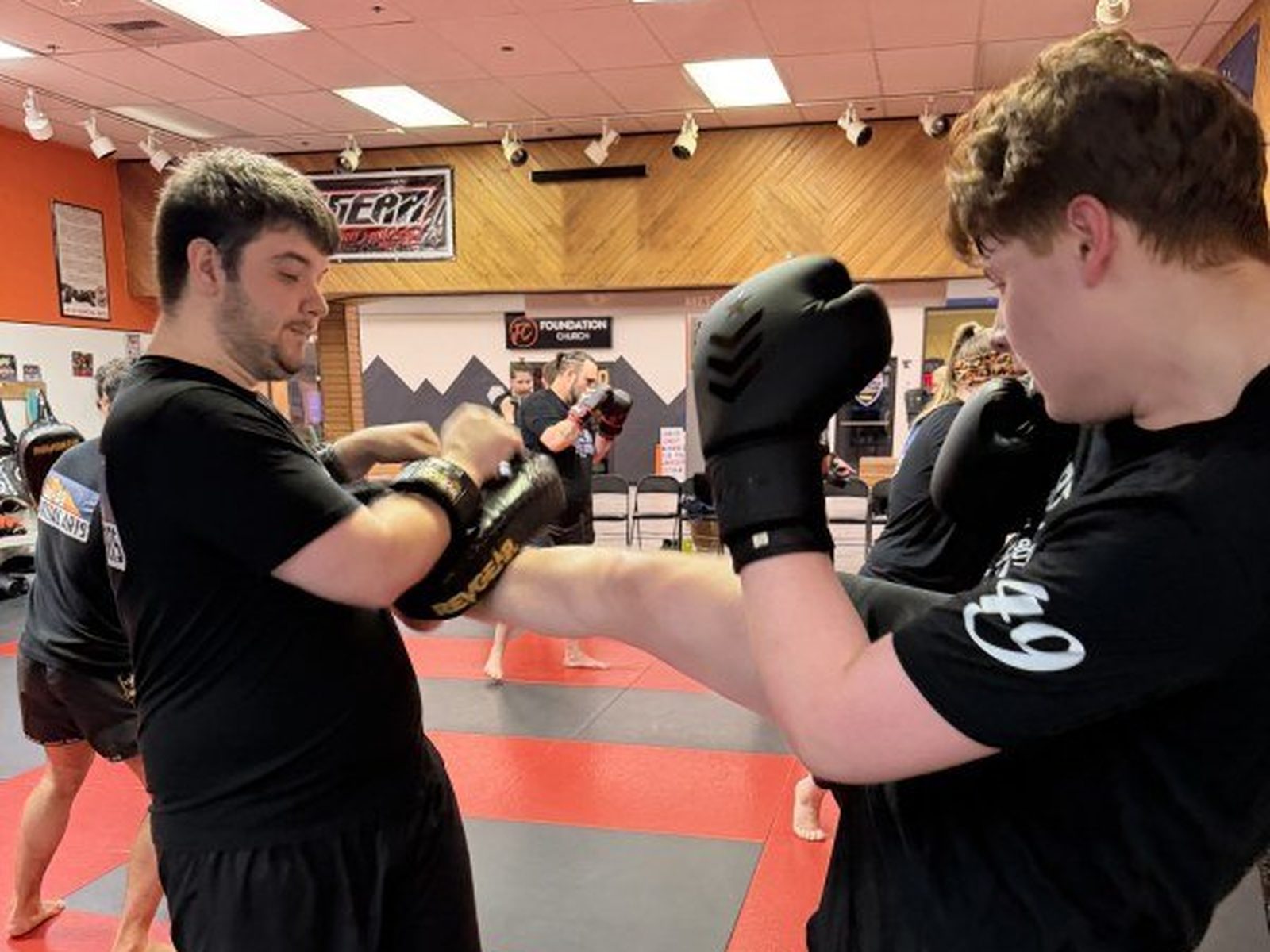
Running moves you in a straight line, and a fight moves in every direction. That's why fighters still do their pad rounds, bag rounds and clinch work on top of the run. The run builds the base, and the rounds in class teach your body to use it while stepping, turning and kicking.
If you're just starting
Let class be your first cardio. Pad work and bag rounds already push your breathing. You work hard for a round, catch your breath, then go again. If you're brand new, getting used to class is plenty for the first few weeks, and you don't need to be fit to start.
Start short and easy. If you want to add running, two or three easy runs a week is a common starting point for beginners. Keep each one around 20 to 30 minutes, at a pace where you can still talk, and mix in walking if you need to. Over time, cut the walking breaks and build toward three or four miles. On winter roads, wear traction on ice and a headlamp or reflective gear in the dark, and start every run with a few minutes of brisk walking.
Things to look out for
Doing too much too soon
You get motivated, start running every day and add miles fast. Your shins, knees and ankles haven't caught up yet, so you end up sore, beat up and missing class.
The fix: Build slowly. Keep the same distance for a few weeks so your muscles and tendons can adapt, then add a little at a time. A common rule is to raise your weekly total by no more than about 10 percent.
Running every run hard
Every run turns into a race against your last time. You're always tired, your legs are heavy in class, and the easy base you're trying to build never gets built.
The fix: Keep most runs easy, at a pace where you could talk in full sentences. Save hard efforts for a sprint day, follow every hard run with an easy one, and put runs on days without a hard class, or after an easy class, so you're not running on legs that are already sore.
Treating running like fight training
You run a lot and figure your cardio is covered. Then a pad round feels like a different kind of tired, because you've been moving in a straight line while a round has you stepping, turning, kicking and holding your hands up.
The fix: Use running to build the base and let class build the rest. Your pad rounds, bag rounds and shadowboxing are where the cardio turns into fighting shape.
Sloppy running form
Your head drops, your shoulders creep up and you take long, reaching strides that land hard on your heels. It wastes energy and pounds your joints on every step.
The fix: Keep your head up, your shoulders relaxed and your arms swinging next to your body. Take shorter steps and land softly under you, about midfoot.
Ignoring pain that keeps coming back
A sore shin or knee shows up on every run and you push through it. A small ache turns into something that keeps you off the mats.
The fix: Back off the running when something hurts and keep training what you can. Wear running shoes that fit your feet, and if the pain sticks around, get it looked at by a doctor or physical therapist. Sharp pain in one spot on the shin, swelling, or pain that hurts while you're resting means stop running until it's checked.
Drills you can practice
Drill 01
Run walk builder
3 times a week, on non consecutive days. Week one, jog 1 minute and walk 1 minute, 10 times, for 20 minutes total. Each week, add a minute to the jog and keep the walk at 1 minute, so week two is jog 2, walk 1, and week three is jog 3, walk 1, keeping each session around 20 minutes. It usually takes two or three months to jog 20 to 30 minutes in a row, and then you move to the base run below. Stay at a pace where you can talk the whole time, and repeat a week if it felt hard.
Drill 02
Easy base run with shadowboxing
Once you can jog 20 to 30 minutes without stopping, do that 2 or 3 times a week at talking pace. When you get home, shadowbox 2 rounds of 2 minutes with 1 minute rest, slow and deliberate. Round one, stance and guard on every strike. Round two, step out to an angle after every combination.
Drill 03
Sprint rounds
Once a week, after a month or more of easy running. Jog 5 to 10 minutes to warm up, then run 200 meters at about 8 out of 10 effort, fast but not all out, and walk 60 to 90 seconds. Start with 4 sprints and build toward 8 over the weeks. Skip the sprints if your legs are sore from class. Finish with a 5 to 10 minute easy jog.
Frequently Asked Questions
How far do Muay Thai fighters run?+
In traditional camps, the morning run is usually three to five miles, and some pros go farther. That's for full time fighters who train twice a day. A beginner doesn't need anything close to that.
Do I have to run to start Muay Thai?+
No. You don't need to be fit to start, and class works your cardio with pad and bag rounds. Running is something you can add later if you want more gas in the tank.
How often should a beginner run for Muay Thai?+
Two or three easy runs a week is a common starting point. Keep them around 20 to 30 minutes at a pace where you can talk. Build up slowly from there.
Is running or bag work better for Muay Thai cardio?+
They do different jobs. Running builds your aerobic base, and bag and pad rounds train the bursts and the movement of a real round. The best cardio is the one you'll keep doing every week.
What if running hurts my knees?+
Running is hard on the joints for some people, especially when you add miles fast. Cut back, try shorter runs, and mix in other cardio like shadowboxing rounds, bag rounds or bodyweight circuits. If the pain keeps coming back, see a doctor or physical therapist.
Are You Ready?