
The Rear Overhand
Boxing | Punches
How to Throw an Overhand in Boxing
The rear overhand is a back hand punch with a small arc that comes over the top of the other person's jab. Throw it from your cheekbone like a straight, turn it over so your thumb is down when it lands, and pivot your back foot so your shoulder covers your chin and your head ends up off the center line. Keep your front hand at your face and bring the punch straight back.
- 01
Good athletic base
Feet about shoulder width apart, lead foot ahead, knees a little bent and your weight in the middle, on the balls of your feet. The overhand's power comes from your feet and legs like every back hand punch. If your stance is off, a missed overhand will pull you off balance.
- 02
Hands up, elbows in
Both fists sit up by your face, at your cheeks, with your chin tucked and your elbows in close to your ribs. Keep the back hand tight on your cheekbone, loaded and ready. The front hand stays at your face the whole time the overhand is out.
- 03
Punch from the face
The overhand starts right from your cheekbone, like a cross. Don't pull the hand back behind your head or drop it first, because that's the wind up a sharp opponent sees coming. For the first part it should look like a straight punch.
- 04
Back to the face
Bring the hand straight back to your cheek once it lands, not in a big loop down and around. Keep breathing steady and let a breath out as it lands. When it's home, you should be back in your stance and ready.
- 05
Small arc over the jab
Halfway out, let the punch curve over the top in a small arc. All the arc has to do is get over their jab. A big looping swing has more power on paper, but it's slow, it opens you up and you'll fall off balance when it misses.
- 06
Thumb down at the end
Turn the fist over so your thumb points down as it lands, and land on the first two knuckles with your wrist straight behind them. Only turn as far as your wrist stays straight. Keep the elbow in until the turn so it doesn't leak out early, and you'll feel the thumb down bring your shoulder up.
- 07
Pivot and drop
Push off the ball of your back foot and turn the heel, and let your back knee bend and drop a little as your weight goes into the punch. Dip your front shoulder a touch so your head lowers and moves off the center line, with your chin tucked, your eyes still up on the target and your back fairly straight. Your weight ends up mostly over your front leg, with your head still inside your front knee, never out past it. It should feel like your body weight is falling into the punch, not your arm swinging.
- 08
Finish covered
At the end, your back shoulder is up protecting your chin and your head is off to the side, out of the line of their counter. From there, come straight back to your guard or step out. If it misses, keep your hands up and roll or step out to the side instead of chasing it. Don't stay stretched out over your front foot.
When to use it
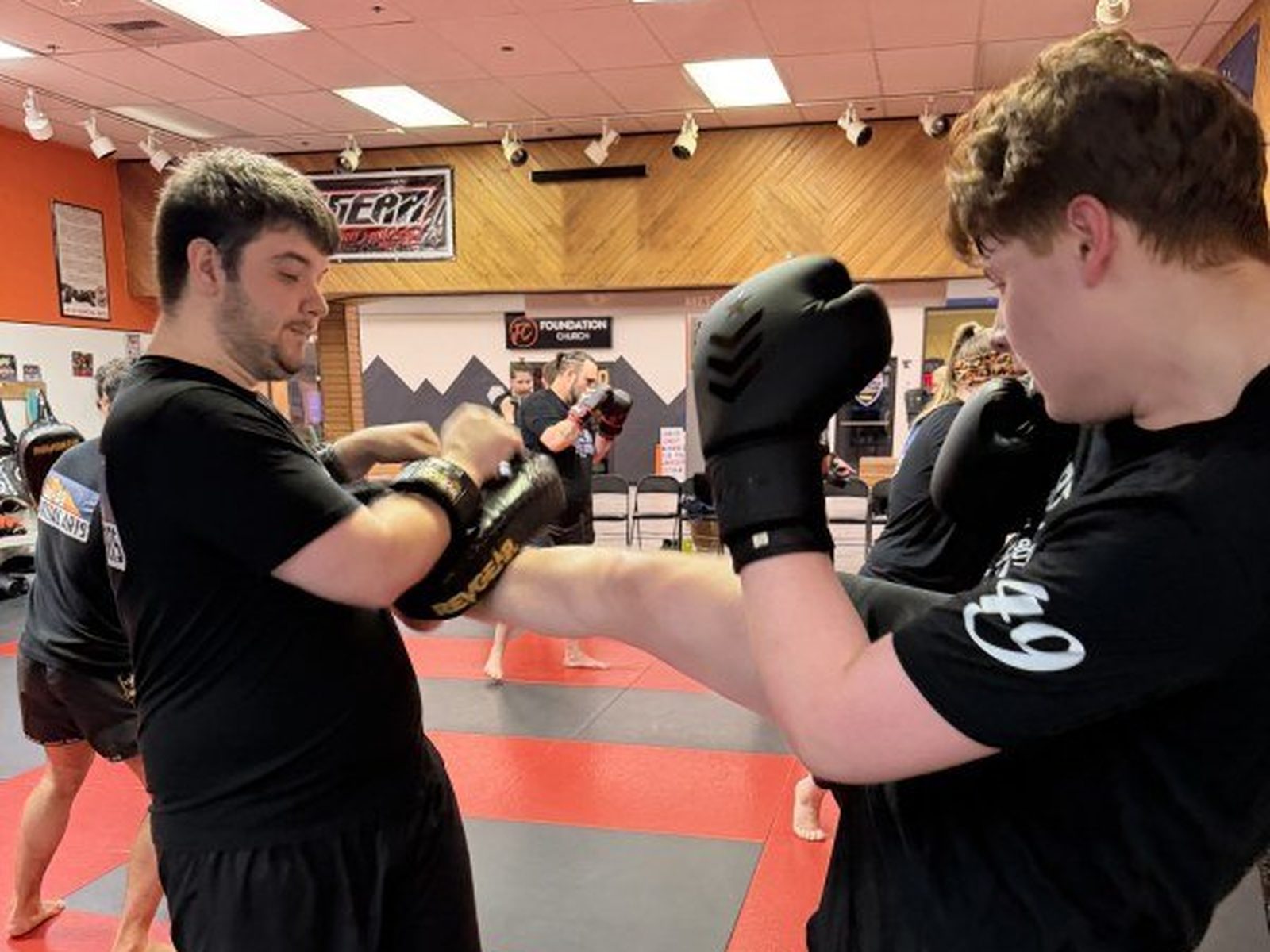
Over their jab. When someone throws their jab and leaves it out there, it covers the straight path to their face. The overhand goes over the top of that arm instead of into it. Your head moves off the line as you throw it, so their jab misses while your overhand comes down over it. In partner drills, this is usually how you first practice it, slowly, with gloves and mouthguards on and light contact, because your heads end up close together.
After a body shot. When you hit the body with a jab or a cross, most people drop their elbows to protect their ribs. That leaves the top of their guard open. Bring the body shot back to your face, then come over the top with the overhand. Body, then head, is one of the simplest ways to land it.
Things to look out for
A big looping arc
You swing the overhand wide like a baseball pitch. It's slow, they see it coming, and if it misses you fall off balance with your chin open.
The fix: Keep the arc small, just enough to get over the jab. Think of a cross that curves over at the end.
Winding up from behind your head
You pull the hand back behind your ear before you throw it. It telegraphs the punch, and your face is open while the hand is back there.
The fix: Start it from your cheekbone every time. If someone watching can see it coming before it starts, it's too big.
Elbow leaking out early
The elbow comes up and out at the start and the punch turns into a wide hook. You lose the straight look that hides it, and your ribs open up.
The fix: Keep the elbow down and the punch straight for the first half, then turn it over. Straight, then over.
Landing on your fingers
The big arc brings the fist down at an angle, so you hit with your fingers or the front of the fist instead of the knuckles. It doesn't hurt them and it can hurt your hand.
The fix: Keep the arc small and turn the thumb down at the end so the first two knuckles land. Keep the wrist straight.
No back foot pivot
The back foot stays flat and the overhand is all shoulder. It feels big but lands light.
The fix: Turn the back heel, drop the back knee a little and let your weight go into it. The power comes from the feet.
Dropping the front hand
The front hand slides down as you throw the overhand. You're turned and close, and their hook lands on the side of your head.
The fix: Keep the front fist on your cheek every time. In the mirror, watch the front hand, not the overhand.
Overthrowing it
You throw everything into it and your head ends up out past your front foot. If it misses, you stumble forward and get hit.
The fix: Throw it from the same distance you'd throw your cross. If you have to reach for it, you're too far, so step in behind a jab first. Against a taller person this matters even more, because lunging to reach them is the most common overhand mistake. You should be able to finish, bring it back and step out without catching yourself.
What to Practice at Home
Drill 01
Mirror overhands
3 rounds of 2 minutes with 1 minute rest, in front of a mirror if you have one. Round one, slow single overhands, checking that it starts at your cheekbone and the elbow stays in until the turn. Round two, jab then overhand. Round three, jab to the body, then overhand, then step out.
Drill 02
Freeze the finish
3 sets of 10 slow overhands with 30 seconds rest. Freeze where the punch lands and check: thumb down, back shoulder covering your chin, head off the center line, back heel turned, front hand on your cheek. Then bring it straight back to your guard.
Drill 03
Three angles on the bag
4 rounds of 2 minutes with 1 minute rest, on a bag if you have one or in the air if you don't. Wrap your hands, wear gloves and stay at half power. The overhand lands on an angle, so build the power slowly over a few weeks while your wrist gets used to it. Picture a clock on the bag: throw the cross straight down the middle, the overhand coming over at about 1 o'clock, and the rear hook coming around at about 3 o'clock. Keep the overhand tight so it lands between the other two.
Frequently Asked Questions
What's the difference between an overhand and a cross?+
They use the same feet and body. The cross goes straight down the middle, and the overhand curves over the top in a small arc to get over the other person's jab. The overhand also lands with the thumb down and your head lower and off to the side.
What's the difference between an overhand and a rear hook?+
They're close. The rear hook comes around the side, and the overhand comes over the top at an angle between a cross and a hook. Dipping the front shoulder a touch is what brings the overhand over instead of around.
Where does an overhand land?+
On the side of the head or jaw, coming down over their jab. It should never land on the back of the head or neck, which is dangerous; if you turn too far or they duck, pull it. On a bag it lands at about 1 o'clock if you picture a clock face. Land it on the first two knuckles with a straight wrist.
What sets up the overhand?+
A jab or a cross to the body, because they drop their elbows to cover. A jab to the head also works, since it keeps them busy with what's in front of them. Over time, you'll learn to throw it right as they jab.
Is the overhand a beginner punch?+
Learn it once your cross feels solid. It uses the same feet and body as the cross, with a different path for the arm. Start slow in front of a mirror and keep the arc small before you add power.
Are You Ready?