Beginner BJJ: Your First Month
Brazilian Jiu Jitsu | Starting Out
Beginner BJJ: What Your First Month Looks Like
Your first month of Brazilian Jiu Jitsu is about learning a handful of positions, how to tap, and how to stay calm when someone is on top of you. Progress feels slow at first because moving on the ground is a new skill, and you learn almost all of it by drilling with a partner before you ever go live. Feeling lost for the first few weeks is normal, and it passes as the pieces start to connect.
What you'll learn in month one
- 01
How to move on the ground
A lot of jiu jitsu happens on your back. So you start with the bridge, the shrimp, the reverse shrimp and the scoot. Think of them as footwork for when you're on the ground: they make space, turn you, and get your legs back between you and your partner. Get those down and every other move comes faster.
- 02
How to tap
Tap twice, clearly, on your partner, the mat or yourself, or just say "tap." Your partner lets go right away, and when your partner taps, you let go right away too. Tap early, before it hurts. It's the most important thing you learn on day one.
- 03
How to get out of bad spots
Beginners spend a lot of time on the bottom, so early classes lean on defense. First you escape the bad spot and get back to your guard. Then you think about attacking. Keep your elbows tucked in to your sides while you work, because an arm stuck out straight is weak and easy to armbar.
- 04
A few positions
You'll learn the names of a few positions. Your guard is the first one: you use your legs to keep your partner in front of you, either wrapped around their waist in closed guard or with your feet and knees as frames. You'll also hear about mount, where someone sits on your chest, and side control, where they lie across you from the side. Knowing where you are tells you what to work on next.
- 05
Staying calm on the bottom
Staying calm when someone is on top of you is one of the main things to work on in your first month. A lot of beginners get tired in one round because they tense up and hold their breath, not because they're out of shape. Breathe out slowly, turn onto your side instead of lying flat, and work one small step at a time.
What helps you get better
Trust your defense first. Confidence on offense comes from trusting your defense, and a lot of good grapplers spend a big share of their training working out of bad spots. For you, that means getting good at the bridge, the shrimp and getting your guard back before you worry about finishes. Once you know you can get out from the bottom, being down there stops feeling so scary.
Drill it, one thing per class. You learn one position, drill it with a partner and repeat it until it feels normal. A class usually covers two or three techniques, and nobody expects you to remember all of it. Take one thing home from each class and jot it down after, with the one detail that made it work. A typical class runs warm up, technique, drilling, and then live rounds at the end for anyone who wants them. Sparring is optional, so you can keep drilling until you want to try it live.
Things to look out for
Treating every round like a contest
You go as hard as you can every round to win it. You tire out in a minute, you don't learn anything new, and going all out with no control is how partners get hurt.
The fix: Use your rounds to learn. Pick one thing from class and try it, and if it doesn't work, that tells you something. Apply submissions slowly, stay away from neck cranks, leg locks and anything your coach hasn't shown you, and let go the moment your partner taps. Roll with partners who move with control, and ask the coach to pair you up if you're not sure.
Waiting too long to tap
You fight a lock or a choke past the point where you can get out, hoping something changes. Holding on is how a good training day turns into time off the mat.
The fix: Tap as soon as you know you can't get out, before it hurts. Then ask your partner what you missed. Nobody will think less of you for it. Sit out instead of training through a sharp pain, and tell the coach about any neck, knee or finger pain that hangs around. A knock to the head means you're done for the day, no contact until you're cleared, and get checked right away for a headache, vomiting, confusion or symptoms that get worse.
Chasing the finishes first
Every white belt wants to learn the cool finishes. If you skip ahead to them, you spend your rounds stuck on the bottom with no way out.
The fix: Learn to stay calm on the bottom and work back to a better spot first. We teach position before submission. Get to a good spot and hold it, then look for the finish.
Holding your breath
You tense every muscle and stop breathing while you fight a position. You gas out after one round and think it's your fitness, when most of it is the tension.
The fix: Breathe on purpose the whole round, long breaths out through your mouth. If you notice your jaw clenched or your shoulders up by your ears, relax them and keep working.
Pushing them off with straight arms
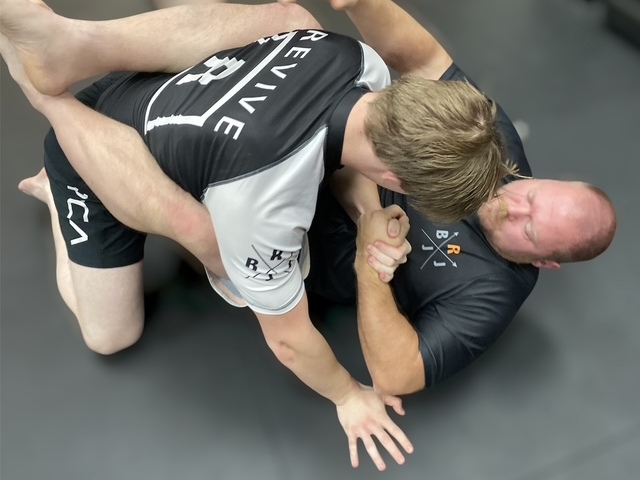
Someone mounts you and you try to bench press them off. It burns your arms out fast, and a straight arm is exactly what they're waiting for to armbar you.
The fix: Keep your elbows tight to your ribs, inside their knees. Use your forearms and knees as frames, then bridge and shrimp to move their weight. Push only as far as you need to make a little space.
Lying flat on your back
You lie flat with your back on the mat and your knees pointing at the ceiling. From there you can't shrimp or get your knees back in, and it's easy for them to pass and pin you.
The fix: Turn onto your side, toward your partner, and curl up a little. From your side your hips can move and your knees can come back inside.
Drills you can do at home
Drill 01
Bridge
Lie on your back with your feet planted near your butt. Look the way you're bridging, drive off your feet and turn up onto the top of one shoulder, with your chin tucked and your weight off your neck and head, then come down and go the other way. This is the move behind the upa, the trap and roll escape from mount. Do 3 rounds of 1 minute, alternating sides, with 1 minute rest. A bridge straight up doesn't help, because they're still on top of you.
Drill 02
Shrimp
Plant your foot out wide, push, and slide your hips away, keeping your elbow and knee close together. Do 3 rounds of 1 minute, switching sides every few reps, with 1 minute rest. Picture someone on top of you while you do it. Shrimping up and down the floor without a picture in your head doesn't carry over to the mat.
Drill 03
Reverse shrimp
Plant the ball of your foot and pull your hips toward it. Plant and pull, over and over, for 3 rounds of 1 minute with 1 minute rest, both sides. It changes your angle when someone gets past your legs, so picture turning to face them as you go.
Frequently Asked Questions
What do you learn in your first month of BJJ?+
How to move on the ground, how to tap, a few positions, and how to get out when someone is on top of you. Most of it is drilled with a partner, one technique at a time. Roughly, the first week is tapping and movement, the next couple of weeks add guard and the escapes from mount and side control, and by week four you start linking two moves together. Two or three classes a week is a good pace. Your coach sets the real pace, and by the end of the month you'll feel a lot less lost than you did in week one, usually able to escape a bad spot now and then against another beginner.
Is jiu jitsu hard for beginners?+
Some of it is. Moving on the ground is new, and good athletes from other sports look lost there at first. It's a lot of new words and new positions at once, so feeling lost early is normal. Learning the base movements early speeds up everything else.
What should I wear to my first BJJ class?+
A shirt and shorts, whatever is comfortable, with no zippers or pockets. Take off your jewelry and trim your nails. Gi students can use a loaner gi, so you don't need to buy anything first. Wash your gear after every class, wear sandals off the mat, and get any rash or skin spot checked and cleared before you roll.
Will I be sore after my first few classes?+
Probably. Expect to feel it in your grip, your core and your neck for the first few weeks, because you're using muscles in new ways. Stretching after class, drinking water and getting good sleep all help. The soreness fades as your body gets used to it.
How long does it take to get good at BJJ?+
There's no set timeline. Jiu jitsu takes a long time to learn, and everybody moves at their own pace. The person who shows up steady for two years usually ends up a lot further along than the person who goes hard for two weeks and quits.
Are You Ready?