
Can a Beginner Just Walk In
Brazilian Jiu Jitsu | Starting Out
Can a Complete Beginner Start Jiu Jitsu
Yes. A complete beginner can start Brazilian Jiu Jitsu with no experience at all, because everybody starts at white belt. You don't need to be in shape or own any gear, and the best first step is telling the coach it's your first class, so you get paired with a patient partner.
How to get started
- 01
Grab a free pass
Your first class is free. Check the schedule, pick a class, and grab a free pass so we know you're coming. If a friend wants to try it too, have them grab a pass and come with you, since something new is easier with a familiar face next to you.
- 02
Come in about 10 minutes early
That gives you time to fill out the waiver, change, and meet the coach before class starts. Shoes come off before you step on the mat, so flip flops or sandals are handy for walking around off it. Showing up rushed makes a nervous first night worse.
- 03
Wear a shirt and shorts
Whatever is comfortable, with no zippers or pockets, and a shirt that fits close so it doesn't end up over your head. If it's a gi class, we have loaner gis, and you wear your shirt and shorts underneath. If you already have a rash guard from training somewhere else, wear it. Bring a water bottle, and a hair tie if you have long hair.
- 04
Tell the coach it's your first class
That way you get paired with a patient partner, and the coach can keep an eye on how you're doing. If you have an old injury, a bad knee or a sore back, say so before class too. The coach can show you another way to do the same move.
- 05
Expect to start on defense
Beginners spend a lot of time on the bottom, so a lot of the first things you learn are escapes and how to get back to your guard, along with a top position or two. Your guard means using your legs to keep your partner in front of you and control the distance. Most of your early rounds start there, so it's the most useful place to begin. You'll also do the bridge, where you drive your hips up onto one shoulder, and the shrimp, where you push your hips away to the side, in almost every warm up.
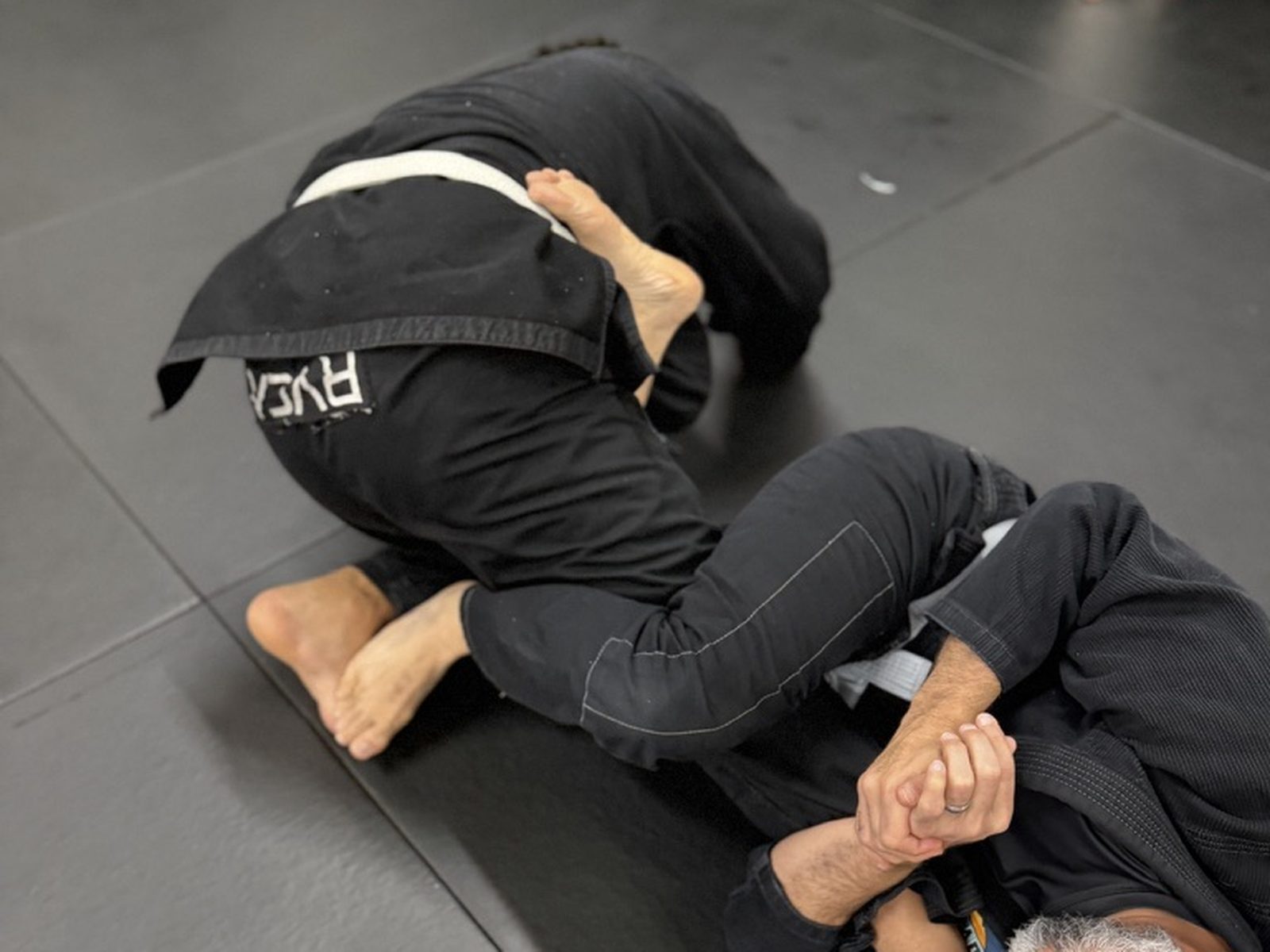
What makes day one easier
Everybody starts at white belt. Every black belt started as a white belt who knew nothing. Nobody expects you to know anything on day one, and your partners were new once too. Watch closely when the coach shows the move, then do it the way it was shown, because every part of it is there for a reason. If you get lost, ask your partner or the coach.
You learn by drilling. Most classes start with a warm up. Then the coach shows a technique and you practice it with a partner, slowly, taking turns. Some classes end with rolling, which is live practice against a partner who resists. Sparring is optional, so you can sit out the live rounds on day one.
Things to look out for
Waiting to get in shape first
You put off your first class for months until you feel ready. The months go by, and that's time you could have spent learning.
The fix: You don't need to be in shape to start. A few weeks of training is what gets you in better shape. Rest when you need to during class, and come back next time.
Buying gear before your first class
You spend money on a gi, a rash guard and shorts before you know what you like. Some of it may not be what you need for the classes you end up taking.
The fix: Come in a shirt and shorts. Members train in gear the gym provides, so wait until you've signed up and ask your coach what you need.
Keeping quiet about being new
You line up like you've done it before and hope nobody notices. You end up paired with someone who expects you to know the drill, and you spend the class guessing.
The fix: Tell the coach it's your first class, so they can pair you with someone patient and keep an eye on how you're doing. Everyone in the room has been new.
Trying to prove yourself
You go as hard as you can to show you belong. You're wiped out ten minutes in, you learn less, and going all out with no control is how partners get hurt.
The fix: Take it slow and learn the move first. Speed and intensity come later, once you know what you're doing. If a partner goes too hard, ask them to slow down, and tell the coach if it keeps happening. Necks, knees and shoulders are what get hurt when people rush, so apply submissions slowly, never crank a joint or the neck, and let go the moment your partner taps.
Holding on instead of tapping
Someone catches you in a hold and you fight it because tapping feels like losing. Holding on too long is how people end up sitting out the next few classes.
The fix: Tap twice, clearly, with your hand on your partner or the mat, or say "tap" out loud. Do it the moment you feel a joint being bent or a choke closing in, before it hurts. Your partner lets go right away, and you do the same when they tap. Nobody will think less of you for it.
Skipping the basics before class
You show up with long nails, a ring on and yesterday's gym clothes. Nails scratch, jewelry catches on a partner, and nobody wants to drill close up with someone who isn't clean.
The fix: Trim your fingernails and toenails short, take off all your jewelry, and wear clean clothes. Leave the makeup off, since it rubs off on your partner.
Drills you can do at home
Drill 01
Bridge
3 sets of 10 with 30 seconds rest. Lie on your back with your feet flat near your butt and your elbows tucked. Drive your hips up and turn onto one shoulder, chin tucked and your weight off your neck, then come down and go the other way.
Drill 02
Shrimp
3 rounds of 1 minute with 1 minute rest. On your back, plant one foot, push off it and slide your hips away to the side, ending on your side with your elbow and knee close together. Switch sides every few reps.
Drill 03
Seated back fall
2 sets of 8 on a soft surface. Sit with your knees bent, tuck your chin and roll back onto your rounded back, slapping the floor with both arms out at your sides as your upper back touches. Keep your head off the floor every rep.
Frequently Asked Questions
Can I do jiu jitsu with no experience?+
Yes. Everybody starts at white belt, and you start with defense and escapes. The coach shows each move and you drill it slowly with a partner. Nobody expects you to know anything on day one.
Do I need to be fit to start BJJ?+
No. You don't need to be in shape to start. A few weeks of training is what gets you in better shape. Expect your grip and your breathing to get tested early, and take a break when you need one. Sore forearms, neck and core for a few days after your first classes are normal.
What do I bring to my first jiu jitsu class?+
A shirt and shorts, whatever is comfortable, with no zippers or pockets. Gi classes have loaner gis. Bring a water bottle, flip flops for off the mat, and a hair tie if you have long hair.
How early should I get to my first class?+
About 10 minutes early, so you have time to fill out the waiver. It also gives you a few minutes to change, meet the coach, and tell them it's your first class.
What if I'm nervous about my first class?+
That's normal. Most people are nervous before their first class, and a lot of them turn out to love it. You'll be paired with a patient partner, sparring is optional, and you can go at a pace that feels right.
Are You Ready?