Half Guard
Brazilian Jiu Jitsu | Positions
Half Guard in BJJ: How to Play It
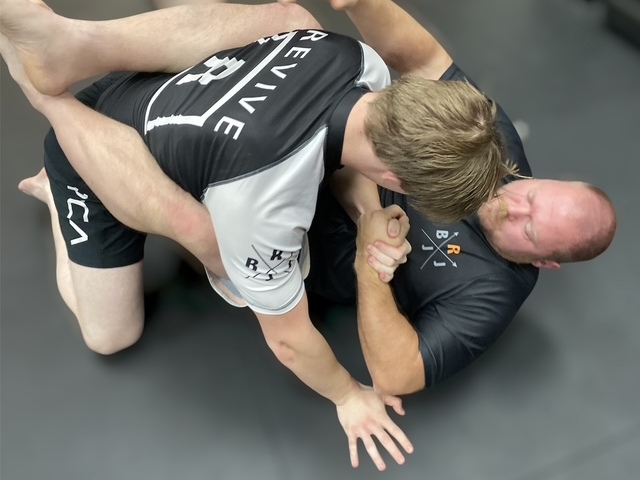
Half guard is when you're on the bottom with one of your partner's legs trapped between yours. To play it well, stay on your side instead of flat on your back, keep them from controlling your head, and keep your elbows and knees inside so you can frame, get the underhook and come up into a sweep.
How to play it
- 01
Trap the leg
Lock your legs around one of their legs, with your bottom leg under their hip and hooked behind their knee. Two of your legs against one of theirs is why half guard works for smaller people. Keep the hook tight, because if that leg slides out, they've passed.
- 02
Stay on your side
Turn onto your side facing them, with your top shoulder, the one away from the mat, lifted off it. Flat on your back, you're one step from being pinned and passed. On your side, your hips can move and your arms can work.
- 03
Keep your head free
They'll try to grab your head or put a shoulder across your face to turn it away. Don't let them hold it for even a few seconds. Keep your head up and close to their chest, and if they grab it, pop it back out right away. The best defense is early: keep your near arm and elbow in front of their shoulder so the cross face can't get across your jaw in the first place. If a cross face does bend your neck hard, don't strain straight against it, and tap if it's cranking your neck.
- 04
Elbows in, frame the far shoulder
Keep your elbows tight to your body, and put your top hand and forearm on the line of their far shoulder. That frame keeps their chest off yours, and tight elbows keep them from sliding an arm under you. Pushing with long, straight arms gets your arms pinned and your elbows pried open.
- 05
Use a knee shield when they get heavy
If they drive into you, bring your top knee across their belly with your shin angled across them like a wall. It keeps their weight off you while you get your frame back. Keep the knee high enough to block, because a knee too low on their hip gets flattened.
- 06
Get the underhook and come up
When they lean forward or reach, slide your bottom arm, the one on the mat side, under their arm on that side and grab around their back. Then come up onto your elbow and toward your knees, head tight to their chest. Your head goes to the same side as the underhook. A head sticking out in front of them is an easy guillotine, and a loose arm can get caught in a kimura, so stay tight. If they block the underhook by wrapping your arm, go back to your frames and try again when they move. From there you're in a position to sweep or get up, which is the point of half guard.
When to use it
When you're about to get passed. When someone is getting past your legs, catching one of their legs in half guard stops them short of side control. It's often the first place you end up when escaping from mount or side control too. For a beginner, half guard is a safe place to catch your breath and rebuild instead of getting flattened. From there, you work back to your side and your frames.
To start a sweep. Half guard isn't somewhere to lie and wait. Once you're on your side with the underhook, you're close enough to their base to knock them over or come up to your knees. The sweeps your coach shows you from here, like the knee lever or the old school sweep, where you come up on the underhook, grab the ankle of their trapped leg and drive them over, all start with that same position.
Things to look out for
Lying flat on your back
You lie flat with both shoulders on the mat and hold their leg. They settle their weight, cross face you and slide their knee free. You're stuck under them with nothing to push from.
The fix: Get on your side with your outside shoulder off the mat, facing them. If they flatten you, frame and shrimp back onto your side before anything else.
Letting them control your head
They get an arm behind your head or a shoulder across your jaw and turn your face away. Once your head is turned, your hips follow, and you're flat and easy to pass.
The fix: Keep your head up, close to their chest. The moment they grab it, pop it back out by lifting your elbow and moving your head.
Pushing with straight arms
You push their chest or face away with long arms. You get tired fast, and they pin your arm across your body or slide under it.
The fix: Keep your elbows tight and frame on their far shoulder with your forearm. A frame is a brace, not a push, so it should feel solid with your elbow bent.
Losing the underhook
You leave your bottom arm on the mat or let them win the arm under you. They take the underhook on that side, flatten you and start passing.
The fix: Fight for that bottom arm under their arm every time they lean forward. Keep your elbow in close so they can't swim inside it.
A knee shield too low
Your knee sits low on their hip instead of across their belly. They drive through it and flatten your leg, and the shield does nothing.
The fix: Put the knee higher, across their middle, and keep your shin angled. Back it up with your upper body frame so they can't just walk around it.
Holding on and doing nothing
You clamp their leg and wait. They settle in, take their time and pass when they're ready.
The fix: Keep moving. Push, pull, bump with your knee and fight for the underhook so they never get comfortable on top of you.
Holding your breath
Someone heavy on top of you makes you tense up and hold your breath. You burn out in a minute and panic.
The fix: Breathe slowly through your nose and keep your frames in place. Half guard is a good spot to slow down and work step by step.
Drills you can practice
Drill 01
Shrimp onto your side
Lie flat on your back. Plant one foot, push your hips out and turn onto your side, bringing your top knee up in front of you like a knee shield. Do 3 sets of 10 on each side with 1 minute of rest. Check that your elbows stay tight and your outside shoulder comes off the mat every rep.
Drill 02
Elbow to knees
Lie on your side as if you're in half guard with the underhook. Come up onto your bottom elbow, then your hand, then onto your knees, keeping your top shoulder in front of your bottom shoulder. Do 3 sets of 8 on each side. Go slow and keep your elbows in close the whole way up.
Drill 03
Shadow half guard
3 rounds of 3 minutes with 1 minute of rest. Picture someone in your half guard. Round one, work getting to your side and framing every time you imagine them pressing in. Round two, add the knee shield when they drive forward. Round three, picture them reaching and take the underhook and come up to your knees. In class you'll do rounds where the top partner tries to cross face you while you keep your head free.
Frequently Asked Questions
What is half guard in BJJ?+
You're on the bottom with one of your partner's legs trapped between yours. It's a guard, so you can still defend, sweep and get back up from it. It's one of the most common positions you'll find yourself in as a beginner.
What's the most important rule in half guard?+
Stay on your side and don't let them control your head. Those two go together, because once your head is turned, you end up flat. Get those right and the rest of half guard gets a lot easier.
Is half guard good for smaller people?+
Yes. You're using two legs to hold one of theirs, and the frames and underhook let you work under someone bigger without trying to push them off. Size still matters against someone just as skilled, but half guard gives a smaller person real options.
Should you stay in half guard?+
Use it to stop a pass and catch your breath, then get to work. The goal is to come up with the underhook into a sweep, or get back to a full guard. Lying there holding on usually ends with you getting passed.
What's a knee shield?+
It's when you put your top knee across your partner's belly with your shin angled in front of you. It keeps their weight off your chest. It works best paired with an arm frame, so they can't just walk around it. In the gi, collar and pants grips change the details a little, but the side, head and underhook rules stay the same.
Are You Ready?