Your First BJJ Class, Step by Step
Brazilian Jiu Jitsu | Starting Out
Your First BJJ Class, Step by Step
Most Brazilian Jiu Jitsu classes go in the same order: a warm up of ground movements, a technique the coach shows, partner drilling of that technique, and sometimes live rounds at the end. On day one nobody expects you to be good at any of it. Your job is to copy what you see, go slow with your partner, and learn how to tap.
How a class goes
- 01
Shoes off at the mat
You train barefoot, so your shoes come off before you step on the mat. Wear sandals or flip flops any time you walk off it, even to the bathroom, and take them off again before you step back on. People's faces end up on that mat, so keep it clean.
- 02
The warm up
Grappling warm ups are mostly movements on the ground: bridging, shrimping, reverse shrimping and scooting across the mat, sometimes with breakfalls and technical stand ups. If you don't know one, watch the person next to you and copy them. Nobody expects these to look clean on day one, and a coach or an upper belt will help you. Try to picture a partner on top of you while you do them, because that's what they're for.
- 03
Watch the technique
The coach shows one move, or a few that connect, on a partner. Sit and watch instead of chatting or lying down, and pick one thing to follow, like where their hands go or where their hips go. If you're lost after the demo, it's fine to ask.
- 04
Drill it with a partner
You pair up and take turns doing the move while your partner lets you. Go slowly and do it step by step the way it was shown, without skipping parts or making up your own version yet. Stop and listen whenever the coach starts talking again.
- 05
Live rounds, if you want
Some classes end with rounds that start from a set spot, like one person in side control, or with rolling, which is free sparring on the ground. Rounds often start on the knees after a handshake or fist bump, though some start standing. Watch the space around you, and if you drift near the wall or another pair, stop and move back to open mat. Sparring is optional, so you can sit this part out on day one and watch.
- 06
How to tap
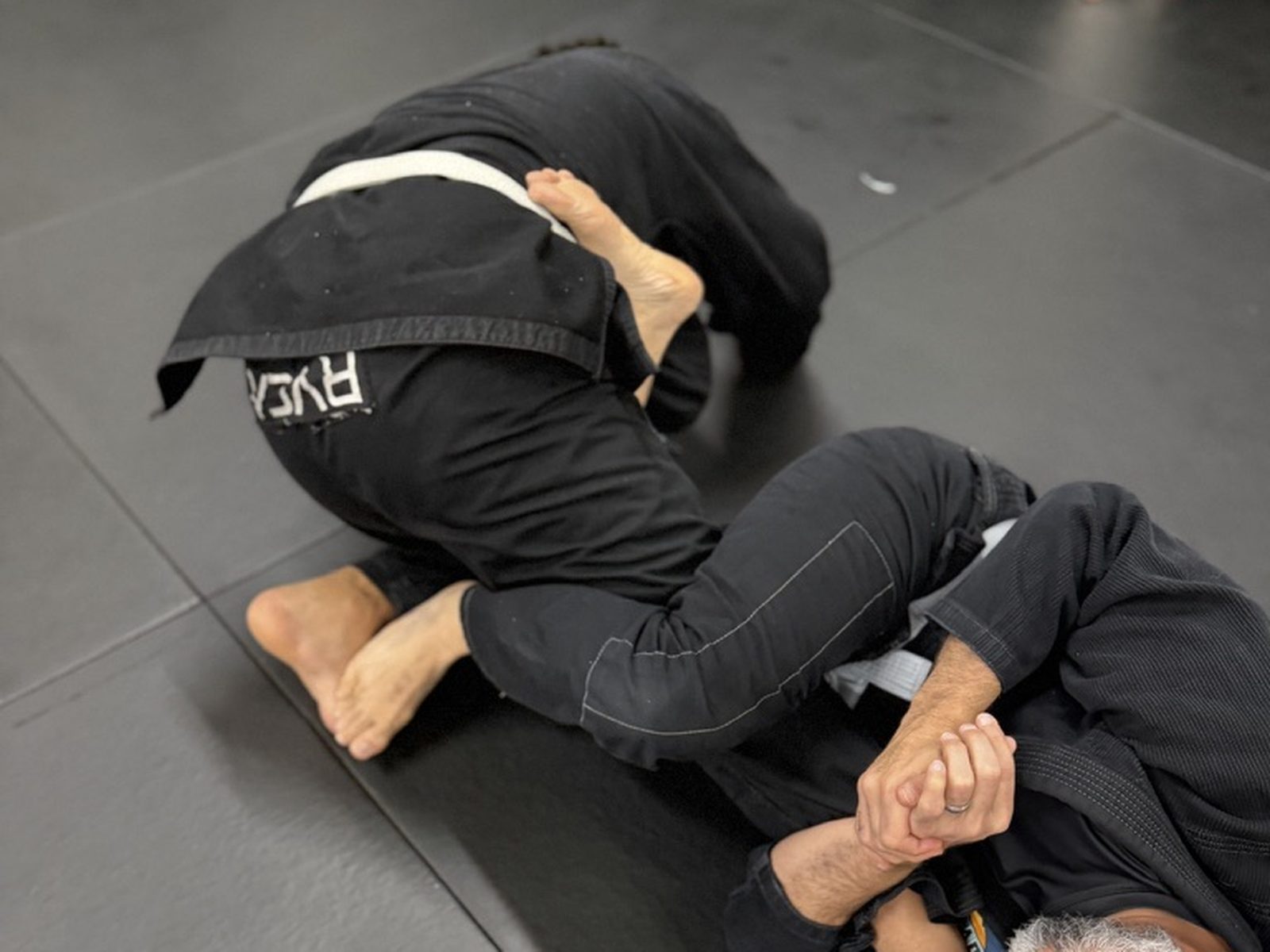
Tap twice, clearly, on your partner, the mat or yourself. If your arms are trapped, tap with your foot or just say "tap." Tap as soon as you feel caught, before it hurts, and any time you feel panic or can't breathe. Tap early on chokes and joint locks. When your partner taps or says "stop", let go right away.
- 07
After class
Shower as soon as you can and wash everything you trained in before you wear it again. Expect to be sore for a day or two, mostly in your grip, your neck and your core. That fades as you keep coming.

Before you walk in
Get yourself ready. Cut your fingernails and toenails short, because long nails scratch your partners. Take off rings, earrings, watches and necklaces, tie long hair up, and come in clean with fresh deodorant. Wear clothes with no pockets or zippers, and cover any small cuts. If you have a rash, an open sore or anything that looks like ringworm, get it checked and cleared before you train. Eat something light a couple of hours before class, since a big meal sits heavy when you're rolling around.
Get there early and speak up. Come in about 10 minutes early so you have time to fill out the waiver and get changed without rushing. Tell the coach it's your first class, so they can pair you with someone patient. If you have an old injury or something that bothers you, tell them that too before class starts.
Things to look out for
Using strength instead of technique
You get stuck and start muscling everything, pushing with your arms and squeezing as hard as you can. You'll be exhausted in a few minutes, and you won't learn the move the coach just showed.
The fix: Slow down and do the steps you were shown, even if they don't work yet. Think hips and position first, arms last. Keep your elbows close to your body, and don't catch yourself on a straight arm when you get rolled, because that's how elbows and wrists get hurt.
Holding your breath
When someone is on top of you, most new people tense up and stop breathing without noticing. You gas out fast and start to panic.
The fix: Keep your breathing slow and steady any time you feel pressure, and keep breathing through the hard spots. Relax anything that doesn't need to be tight.
Going harder than your partner
Your partner is going light and you go all out, or you rip a move on fast. That's how people get hurt, and nobody wants to pair with you next time.
The fix: Match your partner's pace, or go a little slower. Put every submission on slowly so they have time to tap.
Waiting too long to tap
You try to tough it out because you don't want to lose to someone in practice. A joint or a choke can go from fine to hurt very fast.
The fix: Tap as soon as you know you can't get out, ideally before it hurts. Then reset and try again.
Skipping steps in the drill
You leave out the grip or the hip movement because it feels slow, or you make up your own version. The move stops working and you drill the wrong thing.
The fix: Do it exactly the way the coach showed, every step, slowly. Ask your partner or the coach if you're not sure what comes next.
Trying to remember everything
You try to keep every detail from the class in your head and leave feeling like you learned nothing. Most people forget a lot by the time they get home.
The fix: Pick one thing to take home from each class. Small pieces add up fast over a month.
Frequently Asked Questions
What happens in a jiu jitsu class?+
Most classes go warm up, technique, partner drilling, and sometimes live rounds at the end. The warm up is mostly ground movements like bridging and shrimping. Then the coach shows a move and you practice it slowly with a partner. Some classes finish with rounds from a set position or full rolling.
Do I have to roll in my first class?+
No. Sparring is optional, so you can sit out the live rounds on day one and watch. A lot of people like to drill for a while before they try it. When you do start, tell your partner you're new and go light.
How do you tap in BJJ?+
Tap twice, clearly, on your partner, the mat or yourself. If your arms are trapped, tap with your foot or say "tap" out loud. Your partner lets go right away. Tap early, before it hurts, because nothing is gained by waiting.
Will I be sore after my first BJJ class?+
Probably. Most people feel it in their grip, neck and core for a day or two. Drink water, move around a little the next day, and it fades. It gets less every week you keep coming.
What should I bring to my first BJJ class?+
A water bottle, sandals for walking off the mat, a hair tie if you have long hair, a small towel and a change of clothes for the drive home. Train in a shirt and shorts, whatever is comfortable. Gi classes have loaner gis, so you don't need to buy anything first.
Are You Ready?