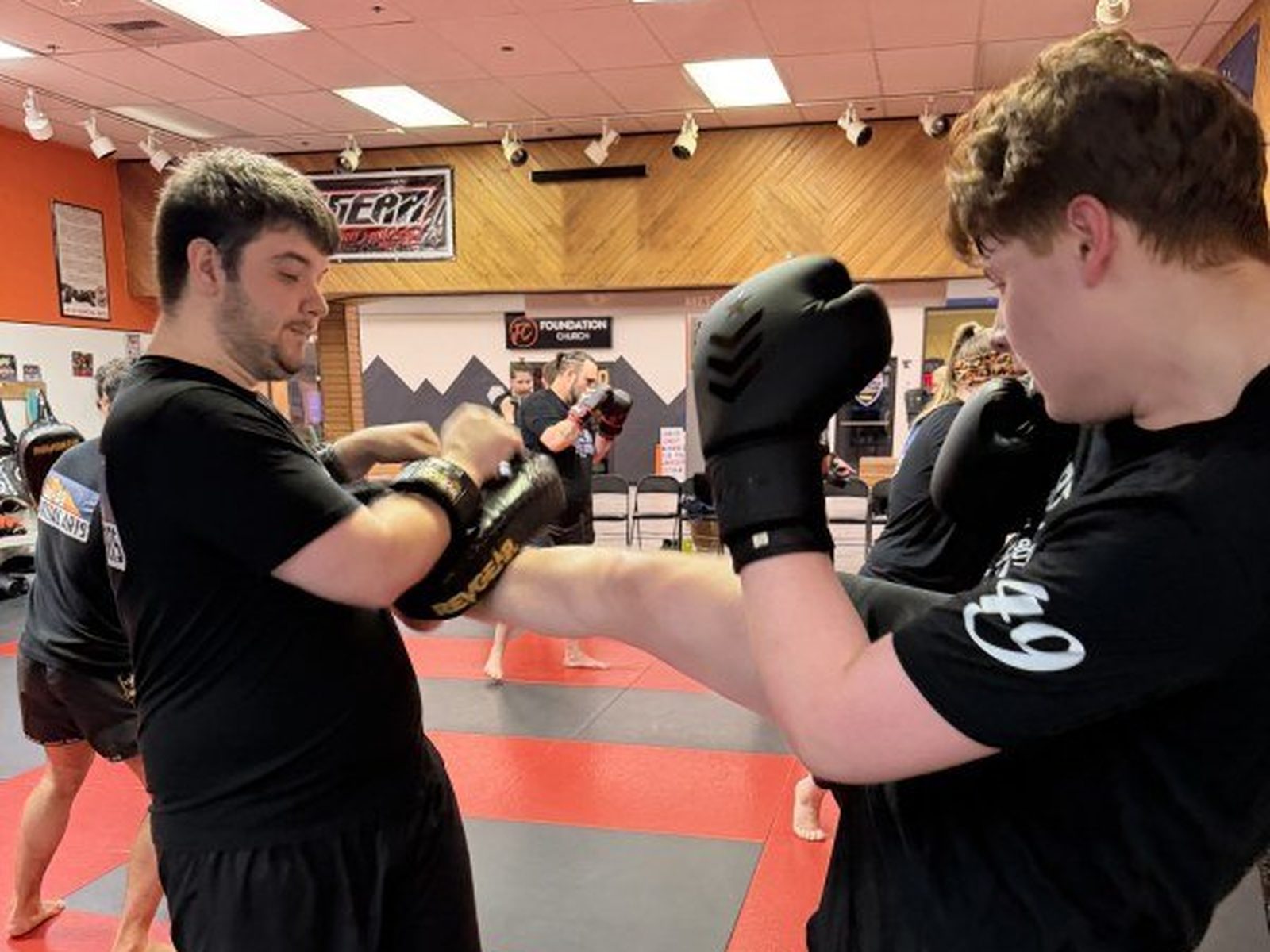
Double Jab Round Kick
Kickboxing | Combos
How to Throw Double Jab, Round Kick in Kickboxing
Double jab, round kick is two jabs followed by a rear leg round kick to the other person's thigh. The jabs close the distance and keep their eyes and hands busy up top, and the kick fires as the second jab comes back to your face. At AK-49 Martial Arts the kick goes low to the leg first; body and head come later, once you can see what's open.
- 01
Good athletic base
Feet about shoulder width apart, front foot ahead with the toes pointing forward, knees a little bent and your weight in the middle. Keep that base through both jabs, with small steps instead of one big lunge. When the jabs are done you need to be balanced enough to stand on one leg and kick.
- 02
Hands up, elbows in
Both fists sit up by your cheeks with your chin tucked a little, and your elbows stay in close to your ribs. Your rear hand stays on your face through both jabs. When you kick, your lead hand stays at your face too, since you're now close enough to get punched.
- 03
Punch from the face
Each jab starts at your face and goes straight out, with no wind up. Reach until the arm is nearly straight with a soft elbow, keep the elbow pointing down, and land on the first two knuckles with a straight wrist. Push off the back foot to move forward instead of leaning in to reach.
- 04
Back to the face
Each jab snaps straight back to your cheek before the next thing goes. After the kick, put the leg down in your stance and get both hands back on your face. Keep breathing steady, and let a breath out as the kick lands.
- 05
First jab closes the gap
Start just out of range and step in with the first jab. It can be a light touch that makes them put a hand up, or a stiff one that pushes them back on their heels. Either way, it gets you moving forward and gets their attention up at their face.
- 06
Second jab gets you in range
The second jab should land from close enough that your kick will land with the shin. If the second jab is falling short, take a slightly bigger step on it. If it's jamming up, you started too close.
- 07
Kick as the jab comes back
Fire the rear leg round kick as the second jab starts coming back, not after it's all the way home and you've paused. The jab coming back starts your hips turning, and that turn is the start of the kick. Come up on the ball of your front foot and turn it out until your heel points toward them as your hip swings over, so the standing knee turns with your body instead of twisting. Don't take another big step, because the jabs already put you in range. The jab and the kick should feel like one move.
- 08
Land low, back to your stance
Land with your shin into the big muscle on the outside of their front thigh, well above the knee and never on the knee joint itself, with your eyes on their chest. Then bring the leg straight back and set it down in your stance, hands on your face. Once it's smooth, you can finish with the cross or another jab after the kick. If they lift the leg to check, your shin meets theirs, so start with light kicks and shin guards when a partner is involved.

When to use it
To get in range for a kick. From outside kicking range, a kick by itself is easy to see and too far away to land well. Two jabs walk you in close enough that the kick lands with your shin. It's one of the first combinations to learn because it teaches you to use your hands to get your feet in range.
To keep their eyes up. Two jabs in a row make the other person think about their face and bring their hands up. The kick comes in underneath, where they aren't looking. If they start blocking the jabs well, that's a sign the kick behind them is going to be open.
Things to look out for
Reaching on the jabs
You lean forward and stretch to make the jabs land instead of moving your feet. Your head ends up out over your front foot, off balance, and you can't kick from there without falling forward.
The fix: Push off the back foot and take small steps so your feet carry you in. Keep your head over your hips. If the jab doesn't reach, step a little more, don't lean.
Dropping the rear hand
While the jabs go out, the rear hand slides down off your face. Then the kick starts with both hands low, and you're standing on one leg with your chin open.
The fix: Keep the rear fist touching your cheek on both jabs and through the kick. Shadow box in a mirror and watch that hand, not the jab. If it moves, slow the whole combination down.
Pausing after the second jab
The jab comes all the way back, you stop, then you kick. The pause tells them the kick is coming, and they have time to lift the leg and check it.
The fix: Start the kick as the second jab is coming back. Practice slow at first, then shrink the gap until the jab and the kick feel like one move. Count it out loud: jab, jab-kick.
One big step
You lunge in with one big step on the first jab. Your stance gets too long, your weight goes forward, and you're not set to kick.
The fix: Use two small steps, one on each jab. Your stance should be the same size after the jabs as it was before. Check your feet in the mirror at the end of each rep.
Kicking from too far away
The second jab barely reaches, and the kick lands with your foot or toes instead of your shin. It doesn't do much and it's easy to catch.
The fix: Make sure the second jab lands from close enough, then kick. On the bag, look for the contact on your shin.
Looking down at the leg
Your eyes drop to the leg before the kick. Your head comes down with them, your hands follow, and the other person sees the kick coming before you throw it.
The fix: Keep your eyes on their chest from the first jab to the end of the kick. You'll find the leg without looking at it. Chin down, eyes up.
Not coming back
The kick lands and you let the leg drop wherever, or stand there with your hands down. You're off balance, too close and open to whatever comes back.
The fix: Bring the leg back and set it down in your stance every time, then hands up. Treat coming back as the last move of the combination. Jab, jab, kick, back to stance.
What to Practice at Home
Drill 01
Shadow box the combination
3 rounds of 2 minutes with 1 minute rest, in front of a mirror if you have one. Round one, slow reps, checking that your rear hand stays on your face on both jabs. Round two, focus on starting the kick as the second jab comes back. Round three, move around the room between reps and land back in your stance after every kick.
Drill 02
Slow motion reps
3 sets of 10 reps with 30 seconds rest. Throw the whole combination at about half speed, and freeze for 2 seconds where the kick would land, with a soft bend in your standing knee and that foot turned out. Check your hands on your face, your eyes up and a slight bend in the kicking leg, then bring it back to your stance. Speed comes later. This drill is about the positions.
Drill 03
Bag rounds
If you have a heavy bag, 4 rounds of 2 minutes with 1 minute rest, with wraps and gloves on. Start a step away from the bag. Keep the kicks at half power for the first few sessions so your shins get used to the bag. Round one, double jab and low kick at thigh height, then step back out. Round two, light touch jabs, kick hard. Round three, stiff jabs, light kick. Round four, mix them up at a faster pace, coming back to your stance every time.
Frequently Asked Questions
Where does the kick land in double jab, round kick?+
At AK-49 Martial Arts it goes low to the thigh by default. Once you're comfortable, you'll also learn to send it to the body or the head, depending on where their hands are. Get the low version smooth first.
When do you throw the kick?+
As the second jab starts coming back to your face, not after it's all the way home. A pause between the jab and the kick gives the other person time to see it and check it. Practice slowly until the timing feels like one move.
Why double the jab?+
One jab often doesn't get you close enough to land a kick with your shin. Two jabs cover more distance and keep their eyes and hands busy up top, so the kick is harder to see. It also gets your hands working before your feet, which is a good habit.
Should the jabs be hard or soft?+
Both work. A light touch makes them put a hand up, and a stiff jab moves them back on their heels. Mix them up on the bag so you can throw either one. With a partner holding pads, they hold a mitt for the jabs and a Thai pad on the outside of their thigh for the kick, and you stay light until they say go harder.
Which leg kicks?+
Your rear leg, the right leg if you stand with your left foot forward. The jabs load your rear hip so the kick comes off them naturally. Kicking with the front leg off a jab is a different combination you'll learn later.
Are You Ready?