
Heavy Bag Drills for Beginners
Kickboxing | Bag Work
Heavy Bag Drills for Beginners
Good beginner bag drills each work one skill: single punches for technique, power shots, the right hand on three different lines, angles after straight punches, stopping the bag's swing, and footwork around a moving bag. Run each drill for a set time or a set number of reps, with your hands up and every punch coming back to your face. Two minute rounds with a minute of rest are a good place to start.
Drills to start with
- 01
Single strike
Before any drill, wrap your hands, put on bag gloves and warm up for a few minutes with shadowboxing. Stand where your punches land with the arm nearly straight and a soft elbow, so you're not reaching. Throw one punch, stop, and check it before you throw the next. Did the two big knuckles land, did the elbow stay down, did the other hand stay on your face? There's no clock on this drill, so take as long as you need. It's the drill to go back to any time a punch feels wrong.
- 02
Power singles, doubles and triples
Throw one hard shot, reset your stance, and throw again. Then two in a row, then three. Every power shot still leaves from your face and comes back to it, and your feet stay under you instead of leaning in to hit harder.
- 03
Three lines for the right hand
Throw your rear hand down three lines. First the cross, straight down the middle. Then the rear hook, coming around the side of the bag at head height with your elbow up level with your fist. Then the overhand, looping up and over the top and coming down at the head. On all three, turn your back foot and hips into the punch. It teaches you that the same hand can come from different directions, and the other hand stays glued to your face on all three.
- 04
Angles off straight punches
Throw two or three straight punches first, then take a small quarter turn pivot or a step to the side and throw again from the new angle. The straight punches set up the angle, the same way they would on a person. A strip of tape on the floor in front of the bag helps you see whether you actually moved.
- 05
Stop the swing
When the bag swings back toward you, stop it with a kick, or touch it with a jab and cross to steady it, then kick. Land the kick with your shin, turn your standing foot so your hip comes over, and keep it at half power until your shins are used to the bag. Try not to stop it with your open hands. It's simple timing practice, like meeting a person as they step toward you.
- 06
Footwork on a swinging bag
Let the bag swing and move with it. Step in and punch as it comes to you, step out as it goes away, and shuffle around the side when it swings past. Walk with small steps, keep your feet from crossing, and add head movement once the footwork feels easy.
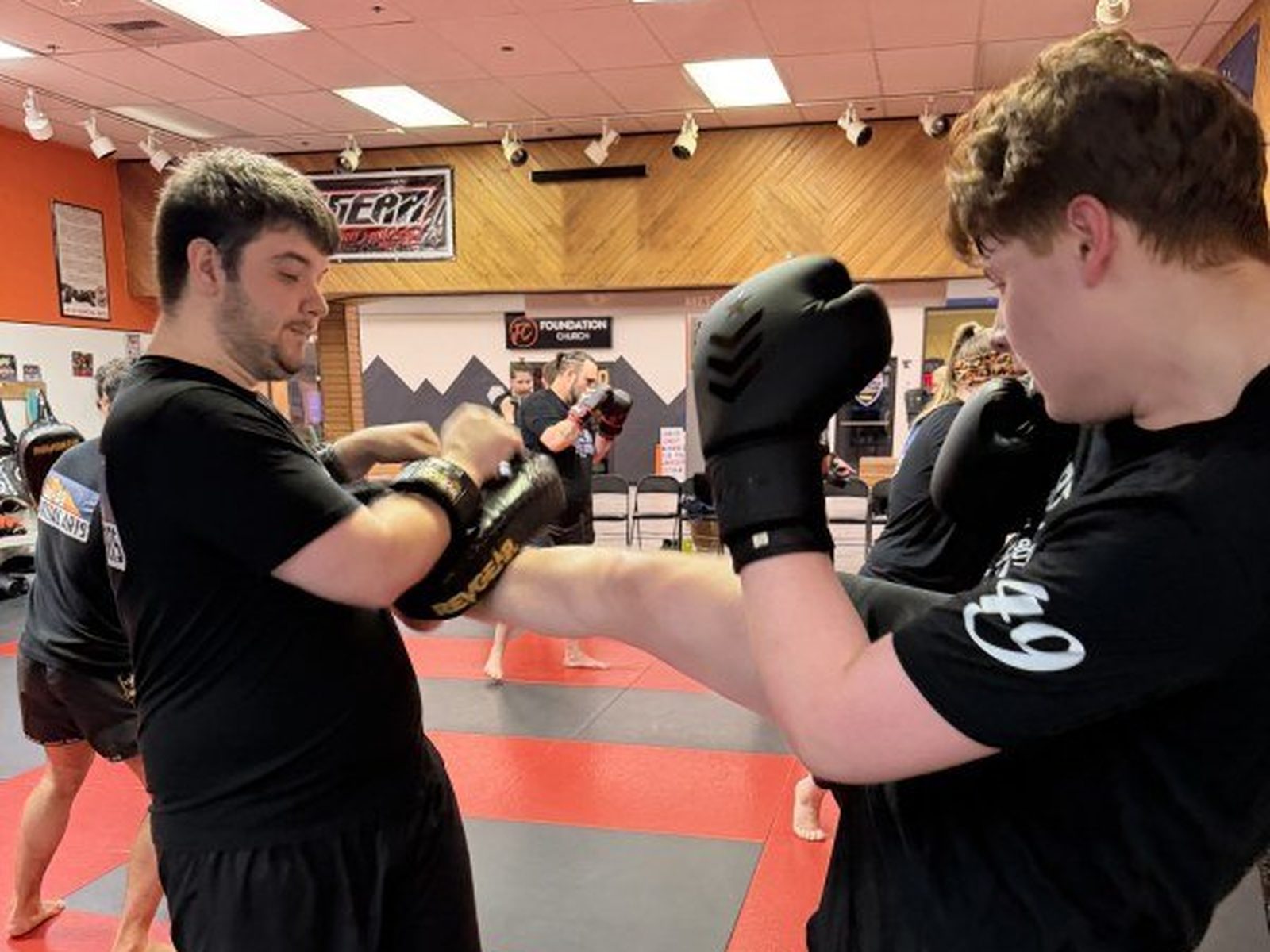
How to structure it
Set a time or a rep count. Give every drill a clock or a number. Start with 2 minute rounds and 1 minute of rest, and build toward three minute rounds, which is how long a kickboxing round is. Technique drills like the single strike can run on reps instead, such as 10 clean punches on each hand. When your form falls apart, the round is over even if the timer isn't.
One goal per round. Pick the drill before the round starts and stay on it the whole time. Random combinations with no goal feel busy, but you don't get better at anything. A lot of drills you'd do with a partner can also be done on the bag, so it's a good place to repeat what you worked on in class.
Things to look out for
Random combos with no goal
You throw whatever comes to mind for three minutes. You get tired, but nothing gets sharper, and the same bad habits get repeated round after round.
The fix: Pick one drill for the round and stay on it. Before the bell, say out loud what you're working on.
Walking back with your hands down
After an angle you drop your hands and stroll back to the middle of the bag. On a person, that's the moment they hit you.
The fix: Jab or step your way back to the middle with your hands at your face. The round isn't over until the bell.
Taking an angle with no setup
You step to the side out of nowhere. On a person, they just turn and face you, so the angle gets you nothing.
The fix: Throw straight punches first, then step or pivot out. The punches make them freeze for a second, and that's when you move.
Hopping around the bag
You bounce and jump to look busy. You waste energy, lose your balance and lose track of your distance.
The fix: Walk around the bag with small steps and keep your feet under you. Plant your feet when you punch and move them when you don't.
Getting sloppy when you're tired
Late in the round the hands drop, the punches turn into pushes and the feet stop moving. That's the version of your technique you're teaching yourself.
The fix: Slow down before the form breaks. Lighter, clean punches with your hands up beat hard, sloppy ones.
Going too hard, too soon
Every drill turns into a full power round on day one. Your form falls apart, and your wrists, knuckles and shoulders take a beating before they're used to it.
The fix: Most of your punches should be around half to three quarters power, which means fast and sharp with room to hit harder. Build up power over weeks, once the form is clean. Keep your wrist straight behind every punch, and stop for the day if a wrist or knuckle starts to hurt sharply.
Drills you can practice
Drill 01
Jab pyramid
3 rounds of 2 minutes with 1 minute rest. Throw one jab, then two, then three, then four, then back down to one, and keep repeating until the bell. Every jab comes back to your face before the next one goes. Round three, do it with the cross instead.
Drill 02
Punch ladder
3 rounds of 2 minutes with 1 minute rest. Alternate jab and cross, starting with 2 punches and going up by 2 each time until you hit 10, then back down. Rest only as long as it takes to reset your stance. If you finish early, start over.
Drill 03
Combo and step out
4 rounds of 2 minutes with 1 minute rest. Throw a jab cross, then step out at an angle back to one side. Throw it again and step out to the other side. Avoid going straight back, and keep your hands at your face while you move. Keep breathing steady the whole round.
Frequently Asked Questions
What are good heavy bag drills for beginners?+
Single punches for technique, power singles and doubles, angles after a few straight punches, stopping the bag's swing with a kick or a jab, and footwork around a moving bag. A jab pyramid and a punch ladder are good timed drills too. Pick one per round and stay on it.
How long should each bag drill go?+
Start with 2 minute rounds and 1 minute of rest, and build toward three minutes, the length of a kickboxing round. Single strike technique work can go by reps instead of time. Stop the round early if your form falls apart.
How many rounds should a beginner do?+
Three or four rounds is plenty at first, plus a warm up before and a few minutes to cool down after. Add a round when you can finish the last one with your hands up and your punches still snapping. More rounds of sloppy work don't help.
Do I need a partner for these drills?+
No. Every drill on this page is done alone on the bag. A lot of drills you'd do with a partner on pads can also be done on a bag. A partner or coach helps most by telling you when your hands drop.
What if my bag doesn't swing?+
A bag that stays still is good for power, because you can set your feet. You can still do the angle and step drills by moving around it. The stop the swing and footwork drills need a bag that moves, so save those for a hanging bag.
Are You Ready?