
How to Hold Pads for a Partner
Kickboxing | Pad Work
How to Hold Pads for a Partner
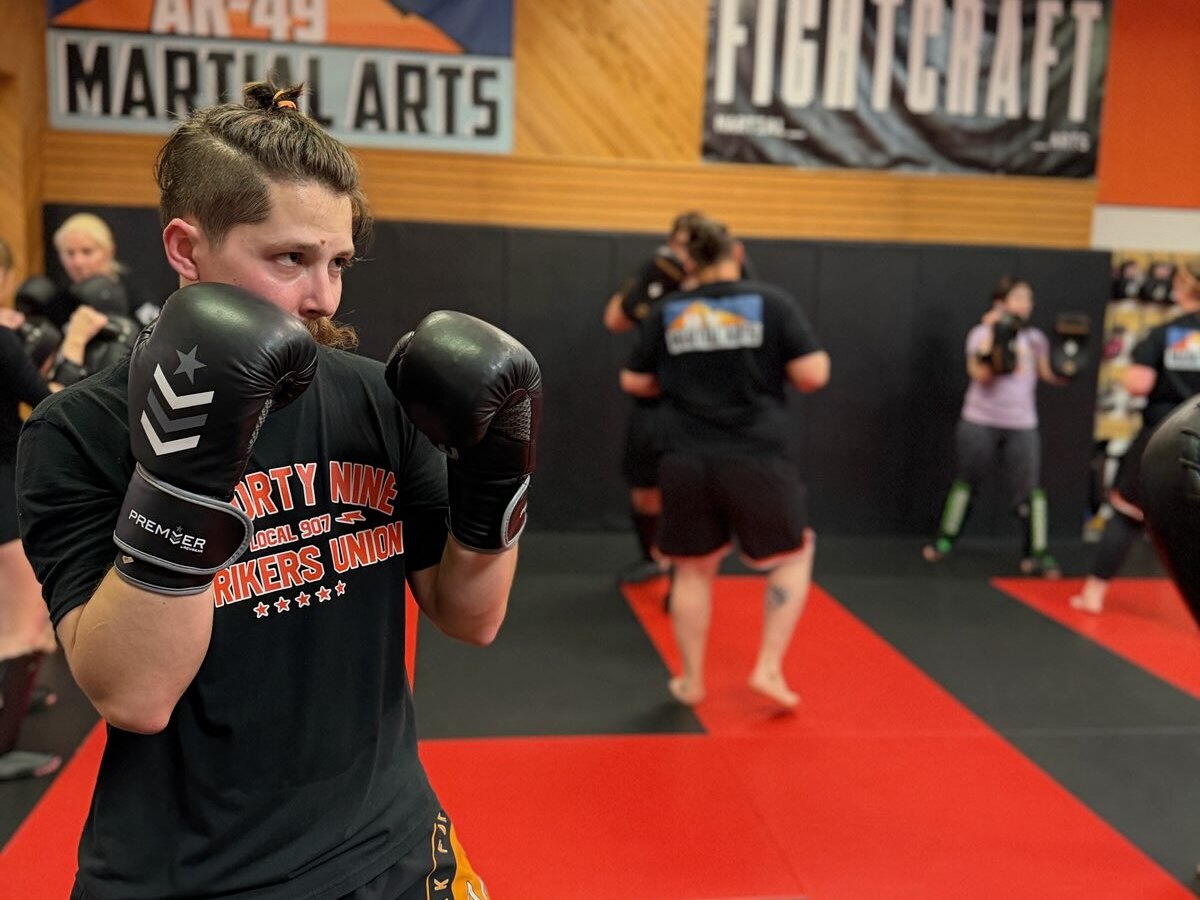
Stand in a good athletic base, keep the pads up with your elbows in and inside your shoulders, and meet each punch with a short, firm push back. Keep the pad still as the punch lands instead of pulling it away. While you hold, watch that every punch starts at your partner's face and comes straight back to it.
How to hold
- 01
Good athletic base
Stand in your own fighting stance, front toes forward, knees a little bent and your weight in the middle. A good base lets you take the punches without getting pushed around. If your feet are flat and close together, every hard punch knocks you back a step.
- 02
Pads up, elbows in
Hold the pads up with your elbows in, close to your body and inside your shoulders. Wrap your fingers over the grip instead of tucking your thumbs under it. Keep each mitt a few inches out in front of your shoulder, not right in front of your face, so a hard punch can't drive it back into your nose. Keep your elbows bent so your arms soak up the punch instead of your wrists. Pads that stay close are steady and give your partner a real target.
- 03
Watch their punches start and finish at the face
While you hold, watch your partner's hands, not just the pads. Every punch should leave from their cheek and come straight back to it, with the other hand staying on their face. If a hand drops, loops or stays out, tell them right away.
- 04
Straight wrists for straight punches
Keep your wrist straight and the pad facing the punch, with a slight tilt forward and down so their knuckles land flat. A bent back wrist makes the pad wobble. Start with that angle, then adjust a little if your partner's wrist doesn't feel right on it.
- 05
Hooks and uppercuts
Catch hooks in line with your nose, with the pad turned to face the punch, not out wide or down low. For uppercuts, turn the mitt so its face points at the floor, held a few inches in front of your chest at about chin height, so the punch comes up into it. Some holders tilt it about 45 degrees toward the puncher instead, and either works as long as the punch has a face to hit. Put each pad where the real target would be.
- 06
Meet the punch, short and firm
Give a short push back into each punch, like a small parry, so there isn't much give when it lands. Don't jam it hard, because that makes your partner's technique messy. Keep the pad still as the punch arrives instead of pulling it away, which makes them overreach.
- 07
Keep your moves small
Move the pads only a little between punches and keep them inside your shoulders. Big motions slow your partner down, and so does popping the pad up to surprise them. Your job is to help them build a rhythm.
- 08
Give them room and move
Before you start, agree on the combo, the pace and how hard you're going. Most holders call punches by number: 1 is the jab, 2 the cross, 3 the lead hook, 4 the rear hook, 5 the lead uppercut and 6 the rear uppercut. Agree on a word like stop, and either of you can use it any time a strike lands wrong or something hurts. Stand far enough away that your partner can fully extend their punches without being smothered. Between combos, step in, step out and move around so they have to use their feet. Keep breathing steady the whole round so you stay loose.
Holding for kicks and knees
Kicks on Thai pads. For a low kick, hold a single pad by its handle at your hip, turned side on, and keep it up at that height, never down by the knee. For a body kick, hold both pads together against your side, flat or with the tops touching, elbows tight, chin tucked, and lean into it a little. Turn to face the kick so it lands square on the pads, and keep the pads a few inches off your ribs so the kick doesn't drive them into you. If a kick comes in crooked or lands on your arm, call stop and reset. The teep is a straight push kick with the ball of the foot, so it goes into a belly pad or a kick shield held flat against your stomach, not into bare arms.
Knees. Hold the Thai pads stacked on your stomach, or wear a belly pad, and squeeze the pads together hard. Relaxed arms let the knee split right through the pads. Tighten your stomach and keep breathing, and let a breath out on the hard knees so they don't knock the wind out of you. Start slow until you and your partner find a rhythm.
Things to look out for
Holding out wide
The pads drift out past your shoulders, far apart. Your partner has to reach and swing to hit them, and they build bad habits throwing punches at targets that aren't where a head would be.
The fix: Keep both pads close, inside your shoulders and a few inches out in front of them, about where a face would be. Before the round, check your partner has wrapped hands and gloves on.
Jamming every punch
You slam the pad into each punch as hard as you can. Their punch never gets to finish, and their technique gets messy.
The fix: Meet the punch with a short push, like a small parry, then let it go. Keep it firm but small.
Pulling the pad away
You flinch or drag the pad back as the punch arrives. Your partner reaches for a target that's gone and overextends.
The fix: Hold your ground and meet the punch. If you're flinching, ask your partner to slow down until you're comfortable. Pulling the pad is usually a sign the pace is too fast for you right now.
Catching hooks low or wide
You hold the hook pad out to the side or down by your shoulder. Your partner learns to throw a wide hook at the wrong height, and a hook loses power past the middle.
The fix: Catch hooks in line with your nose. The pad should be where their hook would land on a real head.
Limp pads
Your arms are loose and the pad flies back on every punch. Your partner gets no feedback, and the pad can bounce back into your own face.
The fix: Keep your elbows in and your wrists straight so there isn't much give when a punch lands. Stay firm without gripping so hard that your arms tire out.
Holding the low kick pad too low
The pad drops down toward your knee. Your partner kicks low into your leg, or learns to kick at the wrong height.
The fix: Hold it by the handle at your hip, turned side on. Keep it there for the whole round.
Bringing your ego
You throw your own strikes back hard or fast, or you try to catch your partner out. It turns their reps into a fight they didn't sign up for.
The fix: Know what the drill is for and let your partner get their reps. If you throw back, keep it light so they can work on their defense.
Drills you can practice
Drill 01
Pad positions in the mirror
3 rounds of 2 minutes with 1 minute rest, with mitts if you have them or just your open hands. Call out a punch to yourself, jab, cross, hook or uppercut, and move your hands to that spot with straight wrists, elbows in, and hooks in line with your nose. Check in the mirror that your hands never go out past your shoulders.
Drill 02
Move like a holder
3 rounds of 2 minutes with 1 minute rest, hands up in pad position the whole time. Step forward, step back, move around in a circle and pivot, landing in your stance every time. This is the movement you'll use between combos to make your partner use their feet.
Drill 03
Shadowbox the combos you'll hold
3 rounds of 2 minutes in front of a mirror. Throw jab, cross, and jab, cross, hook slowly, watching that each punch leaves your cheek and comes straight back. Knowing what clean looks like on yourself makes it easy to spot on your partner.
Frequently Asked Questions
Where do you hold the pad for a hook?+
In line with your nose, with the pad turned to face the punch. Out wide or down low, the hook loses power and your partner learns the wrong path. Put it where their hook would land on a real head.
Should you push the pad into the punch?+
A little. Give a short push back, like a small parry, so the punch has something firm to land on. Don't jam it hard, and don't pull it away. Your partner should feel each punch land solid and finish clean.
How do you hold a pad for low kicks?+
By the handle at your hip, turned side on. Keep it at that height for the whole round. Holding it too low is a common mistake, and it puts your own leg in the way.
How do you hold for uppercuts?+
Turn the mitt face down toward the floor, a few inches in front of your chest at about chin height, or angle it about 45 degrees toward your partner. Keep it close to your body, where a chin or a stomach would be. Hold it flat facing forward and the uppercut has nothing to land on.
What should I watch while I'm holding?+
Watch your partner's hands. Every punch should start at their face and come straight back to it, with the other hand staying on their cheek. Also check that they get back to their stance after each combo. Tell them when something slips, short and simple.
Are You Ready?