Muay Thai Bag Work
Muay Thai | Bag Work
Muay Thai Bag Work for Beginners
Muay Thai bag work trains your punches, kicks, knees and elbows on a bag, usually a long bag that hangs low enough for leg kicks. Give every round one job, punch into your kicks and kick back into your punches, change levels between the head, body and legs, and come back to your stance with your hands up after everything you throw. Wrap your hands and wear gloves every time.
What to work on the bag
- 01
Wrap up and warm up
Wrap your hands and put gloves on before you touch the bag, because bare or loose hands get sore fast. Do a round or two of easy shadowboxing first, and make your first bag round half speed. Your shins and hands need a few minutes to get used to hitting something solid.
- 02
Find your distance
Stand where your jab just reaches the bag with a nearly straight arm. For a kick, step so your shin lands on the bag, not your foot or your knee. If your knee or thigh bumps the bag, you were too close, and if only your foot reaches it, you were too far.
- 03
Punch to kick, kick to punch
Throw punches into a kick, like jab, cross, body kick. Then go the other way and throw a kick back into your punches, like low kick, cross. Learn both directions from the start, and once they're smooth, flow kick, punch, kick. Up close, hold the bag and drive knees in, or throw short elbows at half power until you know exactly where the point of the elbow lands.
- 04
Change levels
Move your strikes between the head, the body and the legs instead of hitting the same spot all round. Picture a person in front of you and hit where their head, ribs and thigh would be. On a long bag, your low kicks land around thigh height, above where a knee would be.
- 05
Back to your stance
Control every kick and bring it back to your stance, with your feet under you and your hands on your face. Spinning all the way around after a missed or heavy kick shows your hips aren't under control. Land in balance, ready to throw the next thing.
- 06
Move and breathe
The bag swings, so move between combinations: step back as it comes at you, step in or to the side as it moves away. Breathe normally and keep it steady the whole round. Let a breath out on your power shots. Stay loose between combinations and only tighten as the strike lands.
Pads or the bag
The bag for power and footwork. The bag is where you build power and practice moving, because you can hit it hard and it doesn't need a partner. You set the pace, so you can slow down and fix your kick or speed up for conditioning. A bag that doesn't move, like a wall or pole bag, is good for digging your shin in on single kicks. A swinging long bag teaches you to time your strikes and keep your balance.
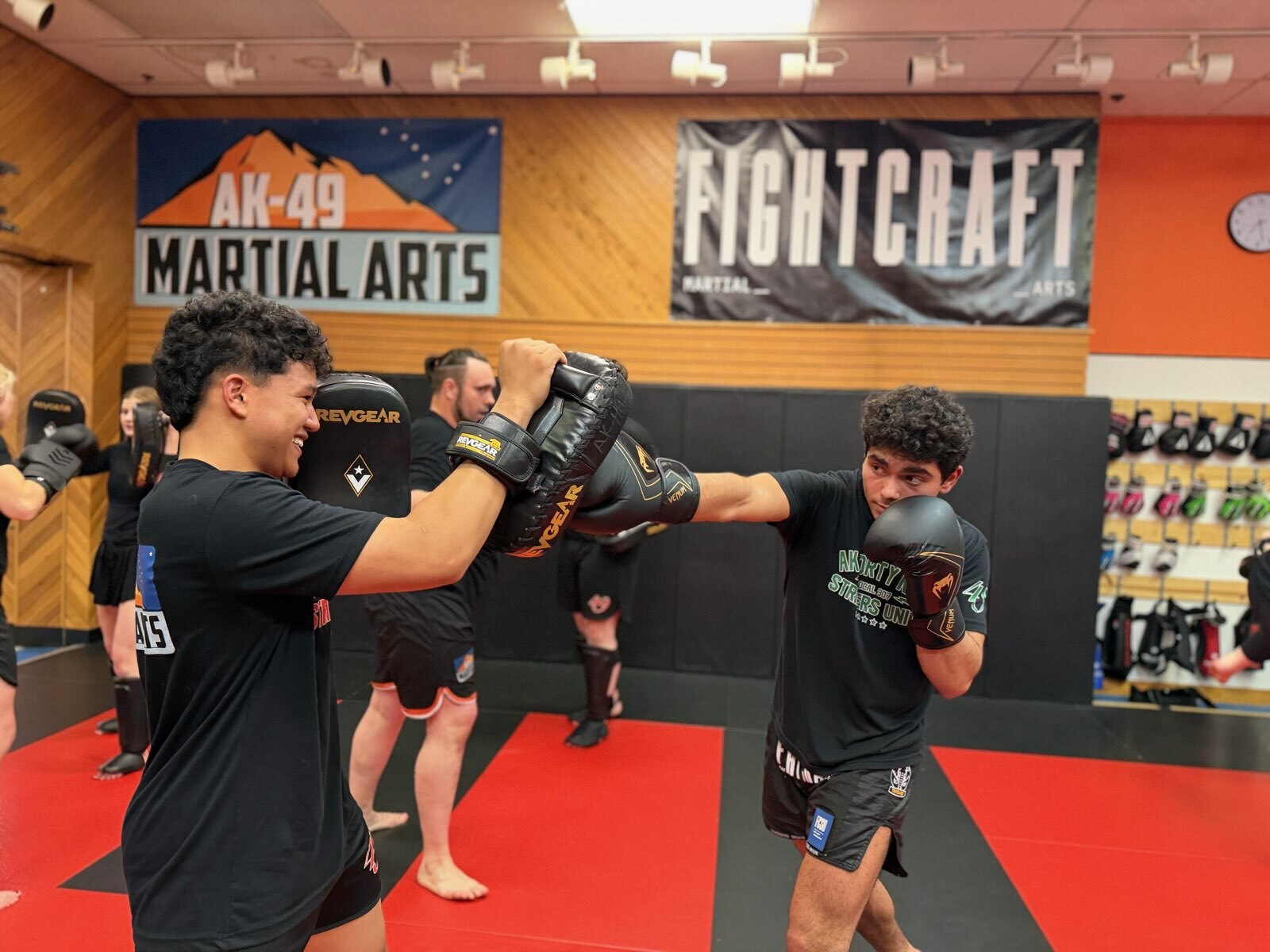
Pads for speed and range. Pad work with a partner builds your speed, timing and range, because the pads move, call strikes and sometimes hit back. The bag can't tell you to keep your hands up, and the pads can. Most classes use both. Take what the pads taught you and drill it on the bag until it feels natural.
Things to look out for
Hitting with no plan
You start the timer and throw whatever comes out until you're tired. You get sweaty, but you do the same three things every round and nothing new sticks.
The fix: Pick the round's job and your two or three combinations before the timer starts. At the end of the round, ask yourself if you did them.
Kicking with your foot
Standing too far away or snapping the kick makes the top of the foot or the toes land first. The kick has no weight in it and the small bones of the foot take the hit.
The fix: Step in so your shin lands, turn your hip over and swing through the bag. If you hear a slap from your foot instead of a thud from your shin, close the distance.
Spinning around after kicks
You throw the kick so hard that you spin all the way around with your back to the bag. On a person, that's the moment you get hit, and it means the kick was out of control.
The fix: Kick at a power you can control and bring the leg back to your stance. Speed and power come after the kick lands in balance every time.
Dropping your hands
The bag doesn't hit back, so hands drift to your chest on kicks, knees and when you get tired. The habit follows you to pads and sparring.
The fix: One hand stays on your face whatever the other one is doing. Throw a punch after every kick so your hands are already back up.
Max power for a full round too soon
Beginners try to hit as hard as they can for three straight minutes. They're gassed halfway through and the second half of the round is sloppy.
The fix: Keep power rounds short, a minute and a half or two minutes, and put technique rounds between them. Get clean first and the power comes with it.
Holding your breath
You tense up and hold your breath through every combination. Your strikes go stiff and slow, and you run out of air early in the round.
The fix: Keep breathing normally, in and out without stopping, and stay loose between combinations.
Drills you can practice
Drill 01
Three beginner rounds
3 rounds of 2 minutes, 1 minute rest, gloves and wraps on. Round one, jab and cross only, moving around the bag after each one. Round two, jab, cross, rear body kick, back to your stance after every kick. Round three, low kick into a cross, then mix it with round two. Two or three sessions a week is plenty to start.
Drill 02
Kick and come back
On a long bag, 3 sets of 10 round kicks on each leg at medium power, with 1 minute rest between sets. Come up on the ball of the standing foot and let the heel turn toward the bag as the hip turns over. After every single kick, put the foot back down in your stance and touch your hands to your face before the next one. Focus on landing with the shin and keeping the other hand home. If a shin bruise stays sore, kick lighter or rest that leg for a few days.
Drill 03
Move around the bag
3 rounds of 2 minutes, 30 seconds rest. Throw one short combination, then move: step back, step to the side, or circle before the next one. Try not to throw two combinations in a row from the same spot. It doubles as a warm up before harder bag rounds.
Frequently Asked Questions
What do you work on a Muay Thai bag?+
Punches, kicks, knees and elbows. Mix punches into kicks and kicks into punches, change levels between the head, body and legs, and come back to your stance after everything. Give each round one job so you're practicing something on purpose.
Why do Muay Thai gyms use long bags?+
A long bag hangs low enough for leg kicks, so you can throw low kicks, body kicks, knees and punches on one bag. A standard heavy bag usually hangs too high for good low kicks. Many gyms also have a teardrop or wall bag for close work and power.
How many bag rounds should a beginner do?+
Three rounds of 2 minutes with 1 minute rest is a good start. Add a round when three feels easy and your hands stay up through the last one. Later you can move to 3 minute rounds, which is the length of a Muay Thai fight round.
Should you spin around after a kick on the bag?+
No. Control the kick and come back to your stance. Spinning all the way around every time shows a lack of control in your hips, and on a person it leaves your back to them. Kick a little lighter until you can land in balance every time.
Do I need wraps and gloves for the bag?+
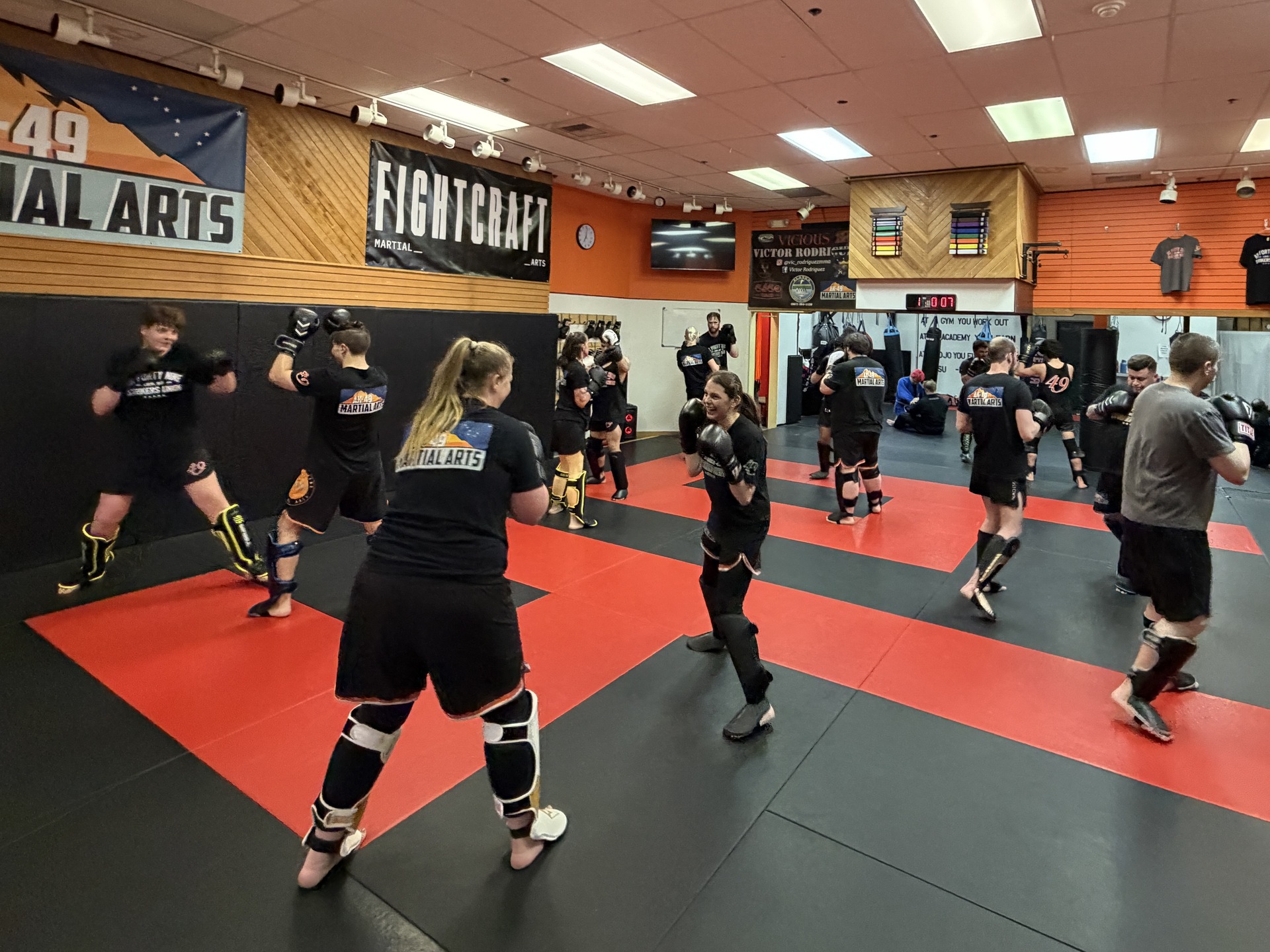
Yes. Wraps help keep your wrist and knuckles lined up and gloves cushion the hit, so your hands don't get sore. Most adults use 12 to 16 ounce bag gloves. Some people wear shin guards for long kicking rounds while their shins get used to the bag. At AK-49 Martial Arts, members train in gear the gym provides.
Are You Ready?