Your First Muay Thai Class
Muay Thai | Starting Out
Your First Muay Thai Class: What to Expect
Your first Muay Thai class is free with a free pass. Class usually runs from a warm up and shadowboxing into your stance, the jab, the cross, the round kick and the teep, then pad rounds with a partner and some conditioning to finish. Wear a shirt and shorts, bring water, and tell the coach about any injuries before you start. You'll be tired and a little awkward, that's normal, and sparring is optional.
How your first class goes
- 01
Grab a free pass
Your first class is free. Check the schedule, pick a class, and grab a free pass so we know you're coming. You don't need any experience and you don't need to be in shape first.
- 02
Get there about 10 minutes early
That gives you time to fill out the waiver, meet the coach and find a spot before warm up. Wear a shirt and shorts, whatever is comfortable and lets you lift your knees. Bring a full water bottle. Gear for class is provided, so you don't need to buy anything first. If you're handed wraps, the coach will show you how to put them on, and the gloves should feel snug with your fist closed.
- 03
Trim your nails and take off jewelry
Take off rings, watches, earrings and necklaces before class, and trim your fingernails and toenails short. A ring can cut your hand inside a glove, and long nails can scratch a partner or tear when they catch on a pad. Most people put their jewelry in their bag or leave it at home.
- 04
Tell the coach about injuries
Let the coach know it's your first class, and mention any old injury that still bothers you, like a bad knee, shoulder, back or wrist. They can show you a way to work around it and pair you with someone patient. If you feel sharp pain, dizziness or sick at any point, stop and tell the coach.
- 05
Warm up
Class starts with a warm up to raise your heart rate and loosen your hips, shoulders and ankles. It might be jump rope, jogging or some easy movement drills. Go at your own speed here and save some energy, because the pads come later.
- 06
Shadowboxing
Next you move around in your stance and throw strikes in the air with no partner. Go slow and pay attention to your feet and your hands. Watching the person next to you is fine. This is where the moves start to feel a little less strange.
- 07
Stance and guard
Feet about shoulder width apart, one foot a step behind the other, knees a little bent and your weight in the middle. Keep your back heel a little off the floor so you can move and turn without getting stuck flat footed. A Muay Thai stance is usually a little squarer than a boxing stance, so either leg can lift to kick, teep or block. Hands up by your face, elbows in, chin down. You come back to this stance after every strike, and the coach will probably fix your feet more than once.
- 08
The jab
The jab is a straight punch with your front hand. It goes out from your face and comes straight back to your face, landing on the first two knuckles with your wrist straight. Reach until your arm is nearly straight with a soft elbow, and keep the other hand on your chin. It should feel quick and light, more of a snap than a shove.
- 09
The cross
The cross is the straight punch with your back hand. Turn on the ball of your back foot so the heel swings out and your hip and shoulder turn with the punch. Same rules as the jab: out from the face, back to the face, the front hand stays up. Let a breath out with this one if it's a power shot, and keep breathing normally the rest of the time.
- 10
The round kick
This is the kick Muay Thai is known for. Step out a little with your front foot, then turn on the ball of that foot so your heel turns toward the target and your hip swings through. Let the standing foot turn all the way with the kick, because a foot stuck flat on the floor twists your knee. Land with your shin, not your foot. Many coaches let the arm on the kicking side swing down for balance, but the other hand stays up by your face. Kick low or to the body at first, and put the leg back down into your stance when you're done.
- 11
The teep
The teep is a push kick. Lift your knee up toward your chest first, then push the ball of your foot straight out into the target and bring it back down to your stance. Think of it as a push, and you use it to keep someone at a distance. You can throw it with either leg, and the coach will start you on whichever one they want.
- 12
Pad rounds
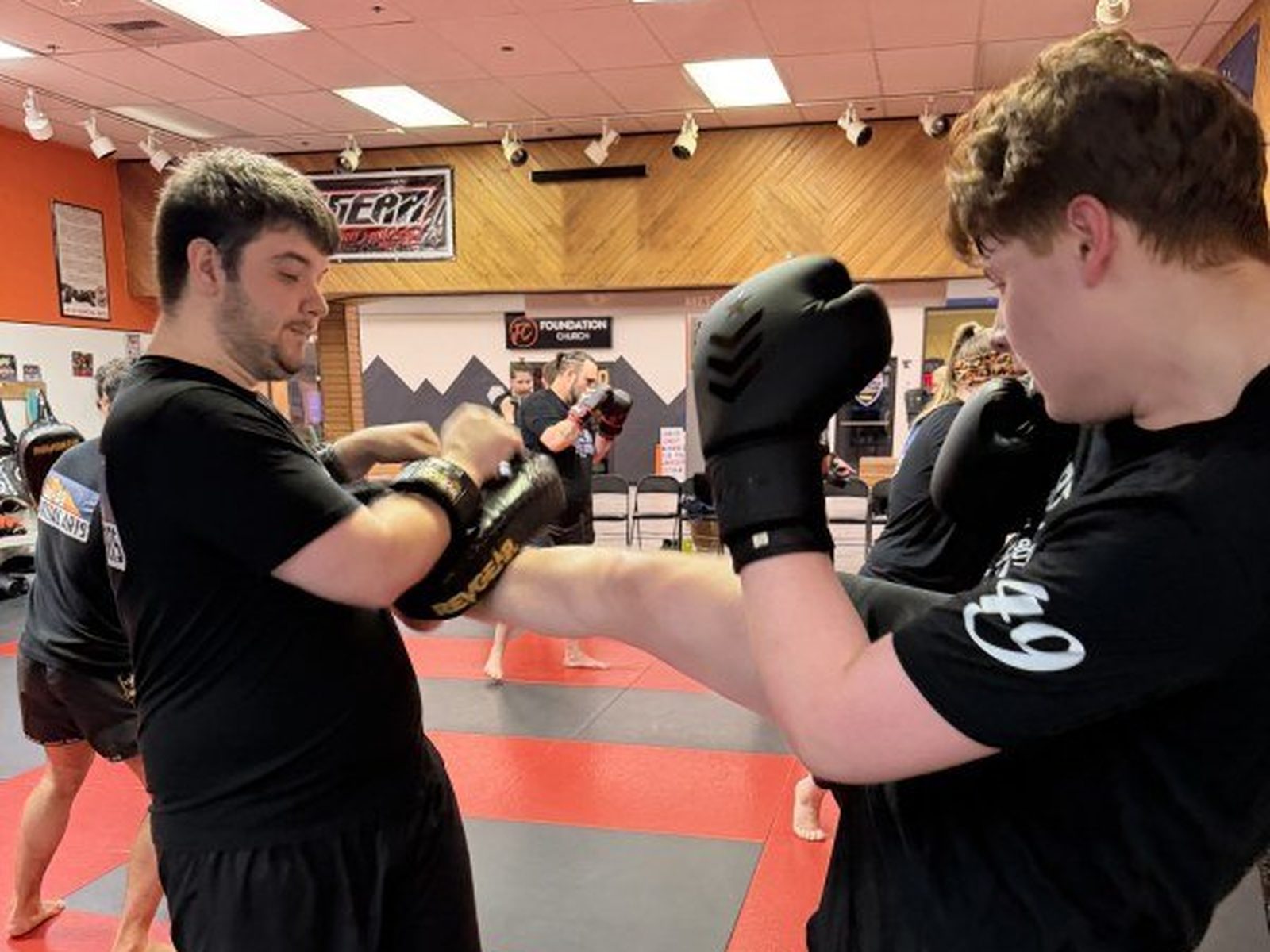
You pair up and take turns. One person holds the pads and the other throws the strikes the coach calls, usually in timed rounds with a short break. Keep your power light, about half, until the coach tells you otherwise. Half power should land with a clean pop on the pad and leave your partner's arms steady. Then you switch, and holding the pads well matters as much as hitting them.
- 13
Hold pads safely
Stand in your own stance with a little weight forward so a kick doesn't push you back. Hold the pads firm with your elbows bent, close but not touching your face, so a strike can't drive the pad into your nose. Meet each strike with a short, firm catch instead of slamming the pad into it. For a round kick, put both pads together on the side being kicked, about rib height, and brace with your arms. For a teep, hold the pads flat together in front of your stomach and brace a little forward.
- 14
Conditioning
Many classes finish with a few minutes of conditioning, like push ups, sit ups, squats or fast strikes on the pads. Do what you can and slow down or take a knee when you need to. Nobody expects a new student to keep up with someone who has trained for years.

What to expect
Light power, your own pace. Half speed with good form teaches you more than full speed with sloppy form, so save the power for later. Your partner is new too, and light strikes keep both of you safe while you learn. Take a break and drink some water whenever you need one, then jump back in. Expect your shins to feel tender after kicking the pads, which is normal on day one.
What week two looks like. Week two covers the same basics again, and they start to feel familiar. The coach usually adds a little at a time, like putting the jab, cross and round kick together, or showing you how to check a kick by lifting your leg with your toes up. Knees, elbows and the clinch are part of Muay Thai too, and they come in over the next weeks once your stance and basic strikes hold up. Your shins will still be getting used to it, so keep the power light. Most beginners do well starting with two classes a week and adding more once their body adjusts.
Things to look out for
Going too hard on day one
You see people who've trained for years and try to match their speed and power. You gas out halfway through, your form falls apart, and you're too sore to come back that week.
The fix: Pace yourself and go at about half power. Think about clean form first. A coach would rather see you come back next week than watch you burn out today.
Slamming the pad into your partner's strikes
New pad holders often swing or jam the pad forward to meet each punch or kick. That can hurt your partner's wrist, knuckles or shin, and it throws off their timing.
The fix: Hold the pad still and firm, then give a short catch as the strike lands. Let the strike come to you. If you're not sure how to hold for a strike, ask the coach before the round starts.
Holding pads too close to your face
When the pads sit right against your face, a hard punch or kick can push the pad into your nose or cheek. It's one of the most common ways a holder gets hurt.
The fix: Keep a little space between the pads and your face, with your elbows bent and your arms braced. Your eyes stay on your partner, not hidden behind the pads.
Kicking with your foot
Beginners often swing the leg and land with the top of the foot or the toes. That hurts your foot, it's easy to jam a toe, and the kick has little behind it.
The fix: Turn your hip through and aim to land with the lower part of your shin. Kick low on the pad at first if your hips are tight. Slow kicks with the right part of the leg beat fast kicks with the wrong part.
Dropping both hands when you kick
Throwing a kick feels like a lot of work, so both hands drop and the chin comes up. In sparring that leaves your face open the moment you kick.
The fix: It's fine for the arm on the kicking side to swing for balance, but keep the other hand up by your face. After every kick, put the leg down into your stance with both hands back up.
Holding your breath
When you're nervous and working hard, it's easy to hold your breath through a whole combination. You tense up, get tired fast and can feel lightheaded.
The fix: Breathe normally and steady the whole time, and let a breath out with your power shots only. Between combinations, slow your breathing down and drop your shoulders.
Training through an injury you didn't mention
People don't want to make a fuss, so they keep quiet about a bad knee or shoulder and push through. A small problem can get worse, and the coach can't help you work around something they don't know about.
The fix: Tell the coach before class starts, even if it seems minor. If something hurts sharply during class, stop and tell them. Sore muscles are normal, but sharp joint pain is not.
Drills you can practice
Drill 01
Stance check
3 rounds of 1 minute with 30 seconds rest, in front of a mirror if you have one. Round one, just hold your stance and check it: feet about shoulder width, one foot a step back, knees a little bent, hands up by your face, elbows in, chin down. Round two, take small steps forward and back without crossing your feet. Round three, step out of your stance and back into it 15 times, checking your hands each time you land. If your hands have dropped below your cheeks when you stop, reset and go again.
Drill 02
Slow jab and cross
3 rounds of 1 minute with 1 minute rest. Throw a slow jab and cross in the air, out from the face and back to the face, nearly straight arm with a soft elbow. Round one, watch that the other hand stays on your chin. Round two, turn the back foot on every cross. Round three, put both together at an easy pace and breathe normally the whole round. Check in the mirror that each fist comes back to the same spot by your face.
Drill 03
Slow round kick and teep
3 sets of 8 each side with 30 seconds rest, holding a wall or chair for balance. On the round kick, turn on the ball of your standing foot, swing the hip through as if landing with your shin, then put the leg back down into your stance. On the teep, lift the knee first, push the foot out, and bring it back down. Go slow and smooth before you go hard. If you wobble or the leg lands somewhere other than your stance, slow down until 8 in a row land clean.
Frequently Asked Questions
What do I wear to my first Muay Thai class?+
A shirt and shorts, whatever is comfortable and lets you lift your knees and kick. Skip anything so loose it flaps around or catches your feet. Take off jewelry and bring water. Gear for class is provided, so you don't need to buy anything first.
Do I have to spar in my first class?+
No. Sparring is optional and nobody is pushed into it. Your first class is about stance, a few strikes and pad rounds, so you don't need a mouthguard or cup for it. When people do spar, they wear a mouthguard and men wear a cup. If you ever take a hard knock to the head, stop for the day, tell the coach, and don't spar again until you're cleared. Get checked right away if you have a headache, vomiting, confusion or symptoms that get worse.
Will my shins hurt from kicking?+
Probably a little. Tender shins and a small bruise are normal in the first few weeks, because your legs aren't used to kicking yet. They toughen up slowly with regular training, so keep your kicks light and don't try to rush it. If you have sharp pain, swelling that keeps getting worse, or pain that doesn't ease after a few days, rest it and get it checked.
Will I be sore after my first class?+
Most likely. Your hips, legs and shoulders do more work than you expect, and holding your hands up for a whole class tires your shoulders fast. The soreness usually eases after a few classes as your body adjusts. Drink water, sleep well, and come back for your next class even if you're a little stiff.
Do I need to be in shape to start?+
No. You don't have to be fit or flexible to start, and the training is what gets you in better shape. Take breaks when you need them and kick low if your hips are tight. Most beginners get tired fast at first, and that's normal.
Can my kid do Muay Thai?+
Muay Thai is an adult program at AK-49 Martial Arts. Kids 7 and up train in Kids Kickboxing, where they learn stance, footwork, punches and kicks with coaching built for kids. Their first class is free with a free pass too.
Are You Ready?