
Why Real Training Matters
Self Defense | If It Gets Physical
Why Real Self Defense Training Matters
Under real stress your skills get worse, so the ones you can count on are the ones you've drilled so many times, against people who push back, that they hold up anyway. That takes regular training over months and years. Awareness and leaving early still come first, and training is what you have if it gets physical anyway.
What regular training builds
- 01
Skills that hold up under stress
When you're scared, your heart rate jumps, your muscles tighten and your coordination gets worse. A review of research on stress and police performance found that skills tend to break down under high stress, and that good training can cut down how much. Regular training is how a move goes from something you know to something your body does when your head is spinning.
- 02
Habits you drilled
How you drill is how you'll react when it counts, so drill it right. Think of walking and talking at the same time: you stopped thinking about it a long time ago. Sloppy reps build a sloppy habit just as well as clean ones build a good one, which is why coaches slow you down to get the details right first.
- 03
Learn it calm, then add pressure
Beginners learn a move slow and calm first, then try it against a partner who resists a little more, a little at a time. Research on police training under stress found that people who practiced against live opponents tended to do better than people who practiced on targets that didn't fight back. Live practice teaches timing and reading a person, which you can't get from a partner who stands still.
- 04
Feel
Feel is knowing where someone's weight is and what they're about to do through your hands and hips, before you see it. Beginners can't feel control of an elbow or a wrist yet, and experienced coaches will tell you it takes years and a lot of reps. Every round you put in adds a little to it.
- 05
Staying calm under pressure
After you've been pinned a hundred times in class, being pinned stops feeling like an emergency. You learn to breathe out, think and work one small step at a time with someone heavy on top of you. In class you tap early whenever you're caught, and in real life the goal is always to get up and get away. That calm is a big part of what regular training gives you, and you can't get it from watching videos.
Against someone bigger
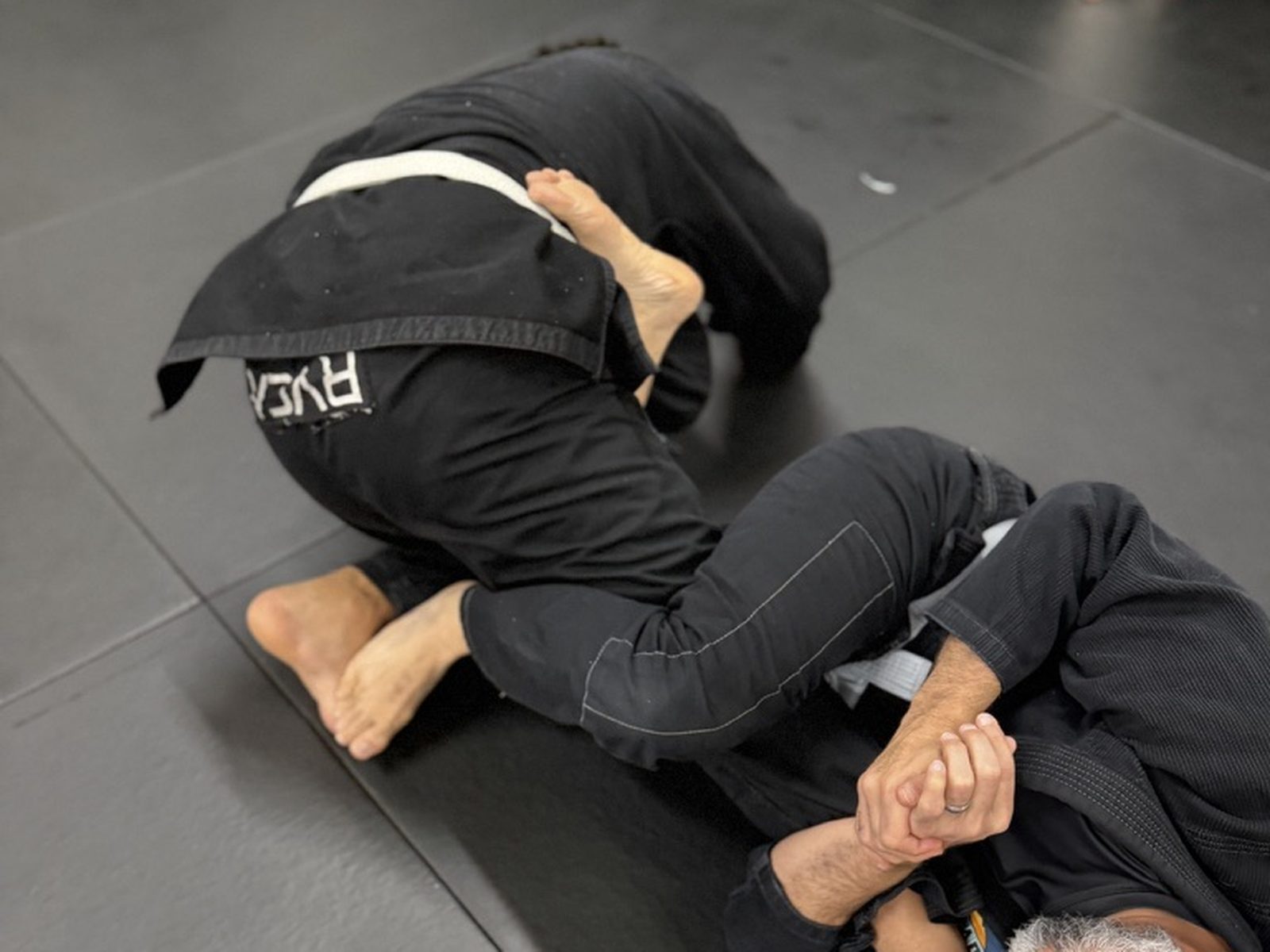
Position and leverage. If someone bigger gets hold of you, pushing back muscle against muscle is a fight you'll lose. Training teaches you to get to a good position first, with your feet under you, your head up and your balance set, and to use leverage instead of strength. You also learn to stay relaxed so you don't burn out in the first thirty seconds while they're still fresh. You also learn to fall without landing on your head or a straight arm, chin tucked and slapping the mat with your arm, and to stand back up safely with a technical stand up. That only comes from doing it against bigger partners in class, again and again.
Get off their straight line. A bigger, stronger person is at their best coming straight forward, and backing straight up in front of them is where you get caught. In training you learn to step off at an angle, usually toward the outside of their lead arm, where it's harder for them to reach you with both hands, with your own hands up in front of you. Coaches teach this for the ring, and for you it's about making space so you can get away. With more than one person or any weapon, getting away matters even more, and the law generally only covers the force you need to protect yourself. Awareness and leaving still come first.
Things to look out for
Thinking a move you saw once will work under adrenaline
You watched a video, tried it on a friend and it looked easy. Under stress, skills you haven't drilled are the first thing to fall apart.
The fix: Drill it until it holds up, against partners who give real resistance at a safe pace. If you've only done it a handful of times, count it as an idea you've seen.
Believing one night makes you ready
You took a class, felt good and figured you're covered. One class won't prepare you against someone athletic and powerful, and feeling ready can keep you in a spot you should have left.
The fix: Keep leaving as your first plan. If you want physical skills, train regularly, even once or twice a week to start.
Only training with partners who let it work
Every rep goes perfectly because your partner gives you the arm and falls the way you want. It feels like progress, but nothing has been tested.
The fix: Once you know a move, practice it against a partner who resists a little more each time. When it stops working, that tells you which detail to fix next.
Going too hard too soon
You go all out in your first weeks because that feels like real training. You tire out fast, learn less, and going hard with no control is how partners get hurt.
The fix: Learn it slow and calm first, then add pressure a bit at a time. Control comes before speed and power, and a coach watches the pace. At AK-49 Martial Arts sparring is optional, so you build up at your own pace. Wear a mouthguard when you spar, and men wear a cup, and if you take a knock to the head, stop for the day and tell the coach.
Training the fight and forgetting awareness
You get good on the mat and start to think the moves are the plan. Walking around tuned out and counting on your skills is backwards.
The fix: Awareness and leaving come first, every time. Your training is what you have if it gets physical anyway, and the confidence it gives you should make it easier to leave.
Showing up once in a while
You come for a week, miss three, come back for a class. Each time you're mostly relearning what you already saw, so it never sticks.
The fix: Pick a schedule you can keep, even two classes a week, and stick to it for a few months. The basics you drill every week are what end up holding up.
Frequently Asked Questions
Why isn't one self defense class enough?+
Skills break down under stress unless you've drilled them a lot. One class shows you the idea, but you haven't practiced it enough, or against enough resistance, for it to hold up when you're scared. A single class can still teach good awareness habits and a plan to leave. The physical part takes regular training.
How long does it take to learn self defense?+
There's no honest number. It depends on how often you train, who you train with, and who you'd be up against. Feel for controlling someone takes years to build, but you'll notice yourself getting calmer under pressure within your first few months. Showing up steady matters more than showing up hard.
What should I train for self defense?+
Brazilian Jiu Jitsu, kickboxing and wrestling, trained regularly, with awareness first. At AK-49 Martial Arts wrestling comes through No Gi, a hybrid of Brazilian Jiu Jitsu and wrestling. Each one lets you practice against partners who push back. The best one to start with is the one you'll keep showing up for.
Do I have to spar to learn self defense?+
At AK-49 Martial Arts sparring is optional, so you can drill until you're ready. Trying moves against a partner who resists is how skills get tested, so it helps a lot over time. You can build up to it slowly, at a light pace with a patient partner. Nobody throws you into it on day one.
Do I need to be in shape before I start?+
No. Training is how you get in shape for it, and nobody expects you to keep up with everyone in your first class. Go at your own pace, rest when you need to, and let the coach know if you have an old injury. Your fitness will come up as you keep training.
Are You Ready?